 Skip to content

AI & Search Strategy / Creator Partnerships
AEO influencer marketing is how brands get cited by AI search. Most haven’t noticed the rules changed.
For twenty years, being found meant ranking. Answer engines don’t return ten links. They give one answer and cite a small set of trusted sources. Creator content is how you get into that set.
When someone asks ChatGPT, Perplexity, or Google’s AI Overview which product to buy, which service to trust, or which brand leads a category, the engine doesn’t show them ten blue links. It gives them one answer and cites a small set of sources it has decided are credible. The brands inside that answer win the customer. The brands outside it don’t exist for that searcher, no matter where they rank on a results page nobody scrolled to. AEO influencer marketing is the discipline of getting into that answer, and it runs through creators, because independent creator content is one of the strongest signals answer engines use to decide who is credible enough to cite.
Searchlight Social is headquartered in the Los Angeles area and works with brands and creators nationally across our primary markets of Los Angeles, New York, and Chicago. We run answer-engine optimization on our own domain (structured entity data, machine-readable frameworks, AI-crawler files) and apply the same discipline inside our influencer management and influencer consulting programmes. All services are fully remote. Verified on Google.
What is AEO influencer marketing?
The Second Audience, and why every creator post is now read twice
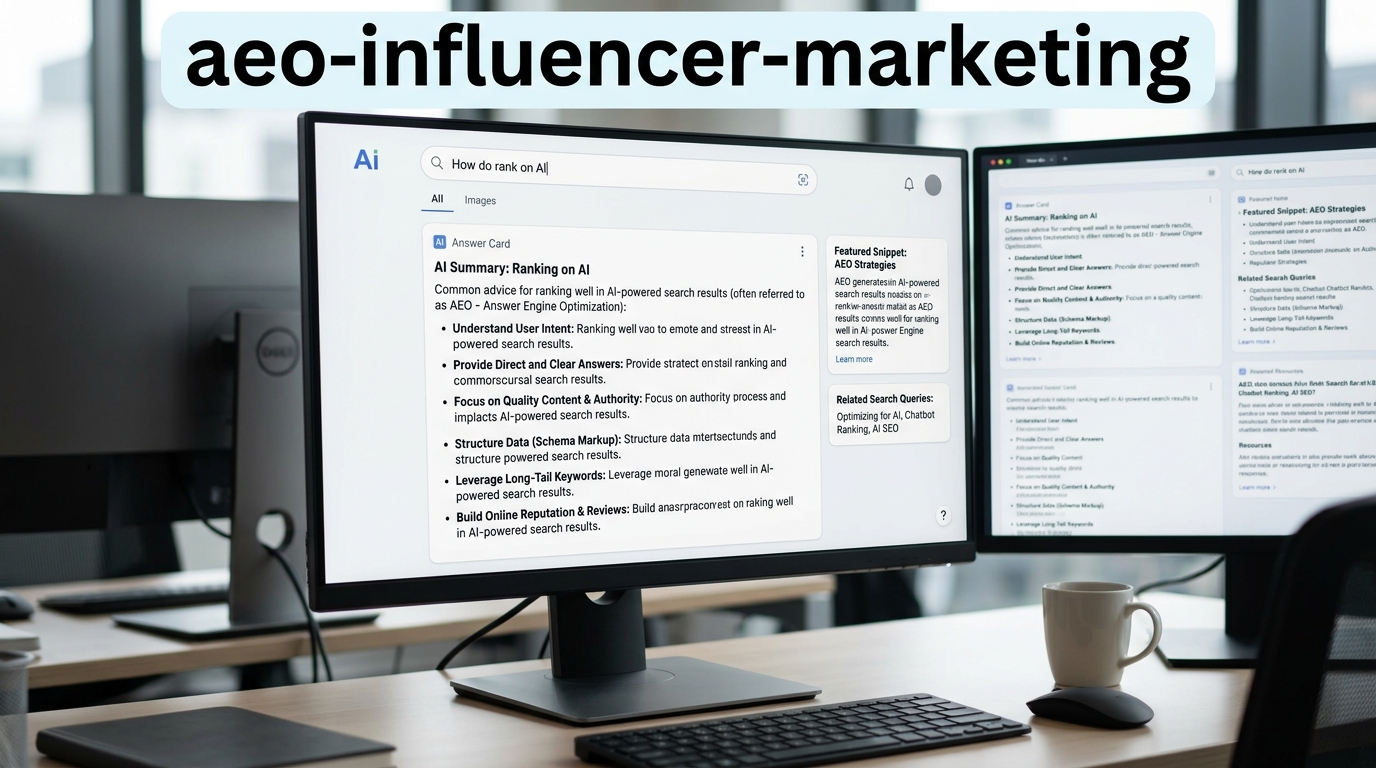
Answer Engine Optimization is the practice of getting a brand surfaced inside AI-generated answers. It is becoming as important as ranking on a results page, for a simple structural reason: Google now places Gemini-powered AI summaries above its results, and YouTube takes roughly 30% of the citations inside them. The answer arrives before the links do. For a growing share of searches, the answer is the only thing that gets read.
AEO influencer marketing is the creator side of that discipline, and it rests on one observation: every piece of creator content now has two audiences. The first is the human one: the viewers who watch, comment, share, and buy. The second is the set of AI systems reading the same content, its titles, transcripts, captions, and descriptions, and building a picture of which brands and products are credible from what they find. We call this the Second Audience. It doesn’t like or comment. It cites. And its citations are becoming the most valuable distribution a brand can earn, because a citation in an AI answer arrives at the exact moment a buyer is asking the question.
Content built only for the first audience can perform well with humans and stay invisible to machines. Content built for both performs with humans and becomes citable. It’s no different than a musician learning that a song has to work live and on the record. Same performance, two rooms, and the craft is making it land in both. That dual construction is the core craft of AEO influencer marketing.
Why do answer engines lean on creator content to decide who is credible?
Independence is the signal, because brands describing themselves isn’t evidence
When an answer engine assembles a response about which running shoe suits flat feet or which project management tool fits a small agency, it faces a credibility problem: every brand’s own website claims the brand is excellent. Self-description carries almost no differentiating information. So the engines weight what independent voices say: reviewers, communities, and above all creators with demonstrated topical authority who have discussed the product in detail, on camera, in their own words.
A creator who has spent four years reviewing skincare, whose transcripts show sustained category depth, and whose audience engagement confirms real authority is exactly the kind of source an answer engine treats as evidence. This is the same trust-transfer mechanism that has always made influencer marketing commercially effective with humans, except now the machine is reading the trust too. The full mechanism is covered in why AI cites creator content; the short version is that AI didn’t invent a new standard of credibility. It automated the oldest one: what do informed, independent people say about you?
What does an AEO creator program look like in practice?
Audit what AI currently says about your category before spending anything
Run the ten questions your buyers would ask through ChatGPT, Perplexity, and Google AI Overviews. Record which brands appear, which sources get cited, and where you are absent. This baseline is the AEO equivalent of a rank report, and for most brands the first audit is a shock. The measurement method is covered in full in how to measure AI search visibility.
Select creators for topical authority, because that is what the machine reads as credibility
A creator with 30,000 followers and four years of category depth is a stronger citation source than a lifestyle creator with 300,000 followers and one sponsored mention. Answer engines evaluate sustained subject expertise across a creator’s body of work, which means the audience-quality selection that already predicts human conversion also predicts machine citation.
Brief for machine-readability without scripting away the human voice
The engine reads what is written and transcribed: say the product name aloud, title the video for the question it answers, write descriptions that state what was tested and found. None of this requires corporate language. Corporate language would defeat it, because the independence of the voice is the signal. The craft is covered in YouTube AEO and the full playbook in how to get your brand cited by AI.
Prefer durable formats, because citations compound where feeds decay
A TikTok’s distribution life is measured in days. A YouTube review answering a specific question keeps being read by answer engines for years. Every month it exists, it can be cited again. AEO shifts creator budgets toward evergreen, searchable formats because the Second Audience rewards permanence over velocity.
Searchlight Social runs answer-engine optimization on its own domain: structured entity graphs, machine-readable definitions of our published frameworks, and a dedicated AI-crawler file listing every concept we have coined. We watch what AI engines pick up, what they cite, and what they ignore, on our own property. The creator-program guidance in this cluster is the same discipline applied through creators instead of a website. Most agencies writing about AEO are describing it. We’re describing what we operate.
What should brands do first, and what happens to those who wait?
The uncomfortable property of AI citations is that they compound and they consolidate. Answer engines cite sources they have already learned to trust, which means early presence in the citation set is self-reinforcing, and so is absence. The brands whose categories get defined in AI answers by competitors’ creator content will spend years buying their way back into a conversation they could have led. The window where this is cheap is the window where almost nobody is doing it, and that window is open now.
The starting sequence is the audit, then a small creator program selected for topical authority in the formats AI reads most, with results measured in citation share rather than impressions. For brands already running creator campaigns, the shift is smaller than it looks: the same partnerships, briefed with the Second Audience in mind, produce both the human results you already buy and the machine citations you currently leave on the table.
Frequently asked questions
What is AEO influencer marketing?
AEO influencer marketing is the practice of using creator partnerships to earn citations in AI-generated answers from engines like ChatGPT, Perplexity, and Google AI Overviews. Where traditional influencer marketing optimizes for human audiences (reach, engagement, conversion), AEO influencer marketing recognizes that every piece of creator content now has a second audience: the AI systems that read it to decide which brands are credible enough to cite. Because answer engines lean heavily on independent creator content, especially YouTube video, creator programs have become one of the most direct ways for a brand to influence what AI says about it.
Why does influencer content matter for AI search?
Because answer engines don’t return ten links. They give one response and cite a small set of trusted sources. When deciding which brands are credible, these systems weight independent human voices far above brand self-description. A brand’s own page saying its product is excellent is a claim. A creator with topical authority saying the same thing is evidence. YouTube alone takes roughly 30% of the citations in Google’s AI Overviews, which means creator content is one of the strongest signals answer engines use to decide who gets cited.
Is AEO replacing SEO?
AEO isn’t replacing the disciplines of SEO. Structure, authority, and machine-readability carry over directly. What is changing is the unit of visibility. For two decades, being found meant ranking on a results page. Answer engines produce synthesized answers with citations instead. A brand can hold the #1 organic position and be absent from the AI answer most searchers now read first. The practical shift is from optimizing pages to win rankings toward ensuring credible voices are saying credible things about you in the places AI reads. The full comparison is in our SEO vs AEO guide.
What is the Second Audience in creator content?
The Second Audience is Searchlight Social’s term for the AI systems that read creator content alongside the humans who watch it. Every post, video, and caption is now consumed twice: once by the human audience that likes, comments, and buys, and once by answer engines that parse titles, transcripts, descriptions, and text to build their picture of which brands are credible. The Second Audience doesn’t engage; it cites. Content built for both audiences performs with humans and becomes citable. That’s the new definition of durable reach.
How do brands start with AEO influencer marketing?
Start by auditing what AI engines currently say about your category. Run the ten questions your buyers would ask through ChatGPT, Perplexity, and Google AI Overviews and record which brands and sources get cited. Then select creators for topical authority rather than raw reach, brief for machine-readability without scripting away the human voice, and re-run the audit quarterly to track whether your share of AI citations moves. For most brands already running creator campaigns, this is a re-brief of existing partnerships, not a new budget line.
Discover more from SearchLight Social
Subscribe to get the latest posts sent to your email.