 Skip to content
Searchlight Social Perspective · August 3, 2026
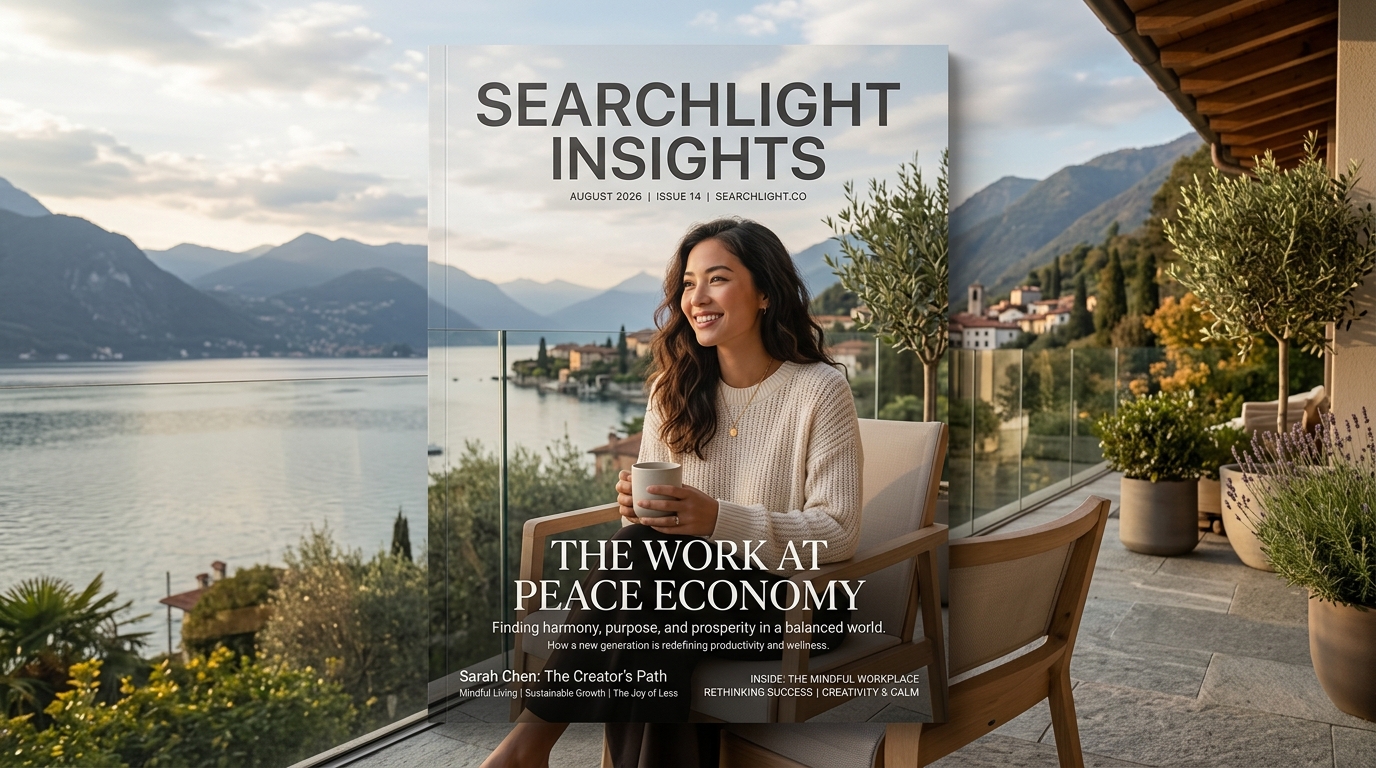
The Future of the Creator Economy Is Work at Peace
Working from home changed the address. The deeper change is the growing refusal to let work consume the life it was supposed to improve.
The future of the creator economy will be shaped by whether creators can convert independence into sustainable control over their lives. The movement began by separating work from offices and traditional permission. Its next challenge is harder: building businesses that preserve autonomy, health, relationships, identity, and peace as they grow.
Working from home was only the visible change
When millions of workers left offices in 2020, the most obvious difference was geography. Dining rooms became workspaces. Meetings became rectangles. Commutes disappeared into login screens.
But location was never the whole argument.
People discovered that many of the rituals surrounding work were not the work itself. They also discovered that removing the commute did not automatically create freedom. A person could work from home and still have no control over the calendar, no separation between work and rest, and no say in what the job required from family life.
The pandemic made remote work visible. The years after it made the distinction clearer: people were not merely searching for a different place to work. They were searching for a different relationship with work.
The Work at Peace Economy
The Work at Peace Economy is work designed around the conditions in which a person can remain whole. It values autonomy, presence, sustainable income, meaningful control, and room for relationships and identity beyond work. Peace does not mean an absence of effort. It means effort that does not require permanent self-abandonment.
The creator economy made life-centered work visible
Creators did not invent self-employment, entrepreneurship, flexible schedules, or independent media. They combined those possibilities in public.
For millions of people, the creator became a visible counterexample to inherited career design. One person could publish without a network, teach without a university, build an audience without a media company, sell without a retailer, and develop opportunity without first being selected by an institution.
That visibility mattered. It did not prove the path was easy, fair, or available to everyone. It proved the path existed.
As creator businesses grew, brands followed. IAB projected that U.S. creator advertising spending would reach $37 billion in 2025, up 26% from the prior year. The economics became substantial, but the cultural impact traveled farther than advertising dollars. People saw work becoming more personal, portable, and directly owned.
Five eras reveal what changed
Location and schedules were determined by production systems. The central asset was labor.
Knowledge moved through institutions. The central asset was expertise inside an organization.
The same employment structure became more flexible. The central asset was connectivity.
Individuals could build direct audiences and markets. The central asset became trust.
Success includes whether income, ownership, presence, health, and identity can coexist.
The Peace Premium explains what people were willing to trade
Traditional economic discussions often assume that workers seek the highest available compensation. Real lives are more complicated.
People routinely accept financial tradeoffs for shorter commutes, safer environments, schedule control, meaningful work, family presence, geographic freedom, or the ability to choose whom they work with. Those benefits have economic value even when they do not appear in salary.
The Peace Premium
The Peace Premium is the value a person places on autonomy, flexibility, presence, and control over how work fits into life. It explains why someone may accept lower short-term income to gain greater ownership of time, and why a well-designed independent business can become more valuable than its revenue alone suggests.
| Traditional compensation | Peace Premium value |
|---|---|
| Salary and bonuses | Control over time and schedule |
| Title and organizational status | Ownership of reputation and direction |
| Employer-provided security | Portable skills, relationships, and income paths |
| Paid time away | A business that can function while the person is away |
| Office flexibility | Freedom to design work around family, health, and place |
The Peace Premium should not romanticize financial precarity. Peace is difficult to protect when income is unstable or basic needs are uncertain. The strongest version of this idea is not choosing peace instead of economic strength. It is designing economic strength that does not routinely destroy peace.
The creator industry can lose the peace while keeping the address
This is the contradiction at the heart of creator work.
A creator may leave a rigid schedule and become available every hour. A creator may escape a manager and become managed by metrics. A creator may gain ownership of the business and then build a business that cannot operate without constant personal output.
The external symbols of freedom can remain while the internal experience disappears.
A Peace Audit for creator businesses
The question is not whether the business looks independent. The question is whether independence is operating in practice.
| Dimension | Question | Warning sign |
|---|---|---|
| Time | Can you step away without revenue immediately stopping? | The business depends on constant posting or personal availability. |
| Income | Is revenue diversified enough to survive one platform or client changing? | One source controls most of the business. |
| Identity | Can your private self remain separate from the public product? | Every experience feels like content inventory. |
| Relationships | Does the business make reliable presence possible? | The people closest to you receive only what work leaves behind. |
| Choice | Can you decline work that conflicts with your values or direction? | Financial design makes every offer feel compulsory. |
| Growth | Does growth reduce fragility or increase it? | More revenue creates more dependence on your immediate labor. |
What will happen to creator work between 2026 and 2031
1. Creators will adopt the Media Company Mindset
The strongest creator businesses will separate the public voice from the operating system behind it. Editorial planning, production, distribution, partnerships, community, commerce, finance, and AI-supported workflows will become distinct capabilities.
The goal is not corporate complexity. It is reducing the creator’s role as the permanent bottleneck.2. Human judgment will become more valuable as content becomes abundant
AI will make competent production inexpensive. The differentiator will move toward taste, trust, lived experience, discernment, and a recognizable point of view.
3. Personal brands will become portable career assets
More people will build direct reputations that travel between employers, clients, products, ventures, and industries. Audience will become one form of professional resilience.
4. Revenue will move beyond sponsorship dependence
Creators will combine partnerships with products, licensing, subscriptions, education, consulting, events, services, and ownership. Diversification will be less about maximizing income than protecting choice.
5. Small, trusted audiences will gain commercial power
Brands will become more interested in relevance, credibility, and action than surface-level reach. A smaller community with strong trust can be more valuable than broad but weak attention.
6. Coaching will focus on business design and independence
Mature creators will need help deciding what to build, price, accept, refuse, delegate, and protect. Good coaching will transfer decision capability instead of making itself permanently necessary.
7. The quality of the life behind the business will become part of performance
Creator success will increasingly be evaluated through sustainability: operating margin, concentration risk, time freedom, team health, ownership, and whether the business can survive without consuming the person at its center.
AI does not remove the human reason to follow
AI can produce a tutorial, summarize a report, draft a script, and imitate nearly any established style. It cannot independently accumulate a human life, accept consequences for a belief, or build trust through years of visible judgment.
Creators should use AI aggressively where it removes low-value friction. They should be equally disciplined about protecting the part of the work that creates a reason to care who made it.
When content becomes infinite, human attention will not disappear. It will become more selective. People will follow voices that help them interpret abundance, not merely add to it.
Work at peace is not work without ambition
Peace can sound passive until it is tested against a serious life.
It takes ambition to build something durable. It takes discipline to price correctly, create boundaries, decline misaligned opportunities, develop a team, and construct revenue that does not collapse during rest. It takes courage to resist definitions of success that reward visible growth while ignoring private cost.
Work at peace is not an escape from demanding work. It is a demand that the work justify what it requires.
Frequently asked questions
What is the Work at Peace Economy?
The Work at Peace Economy is Searchlight Social’s term for the next evolution of work: designing work around the conditions in which people can remain whole, present, autonomous, and economically sustainable. It is not the absence of effort or ambition.
Is working at peace the same as working from home?
No. Working from home describes location. Working at peace describes the relationship between work and life. A person can work remotely and still be controlled by constant availability, unstable income, or platform pressure.
Did COVID-19 cause the Work at Peace Economy?
COVID-19 accelerated it by proving that many forms of work could be untethered from offices and by prompting people to reconsider the costs of traditional work. The underlying desire for autonomy, presence, and meaningful control existed long before the pandemic.
What is the Peace Premium?
The Peace Premium is the value people place on autonomy, flexibility, presence, and control over how work fits into life. Some accept lower short-term income to gain it, while well-designed creator businesses may eventually increase both income and peace.
Can creators really work at peace?
Yes, but not automatically. Sustainable peace requires pricing discipline, boundaries, diversified revenue, owned audience access, repeatable systems, selective partnerships, and enough operational support that the creator is not the permanent bottleneck.
How does Work at Peace relate to the Great Realignment?
The Great Realignment describes the broader cultural movement toward agency and ownership. The Work at Peace Economy describes one of its most important outcomes: work designed to support a life rather than consume it.
Season 1: The Evolution of Work
How are creators changing what work can become? Read the complete season in any order.
Build a creator business that can hold your life
Searchlight Social combines creator coaching, strategic representation, and commercial guidance to help creators build durable businesses without surrendering the independence they were trying to gain.
Explore Creator CoachingDiscover more from SearchLight Social
Subscribe to get the latest posts sent to your email.