 Skip to content
What Is a Non-Exclusive Influencer Agency? Priority Without Restriction
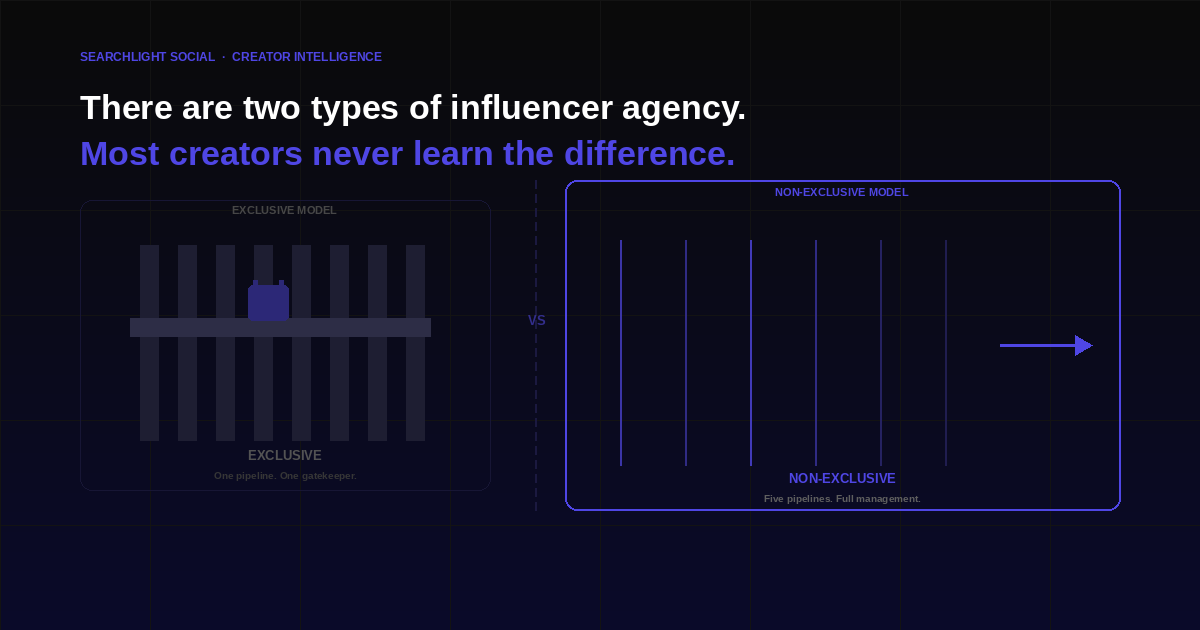
Most creators think there is one kind of influencer agency. There are two — and they operate on completely different assumptions about who controls your opportunity. Understanding the difference is the most important business decision you will make as a creator.
A non-exclusive influencer agency professionally manages a creator without controlling every deal source. The creator keeps the freedom to accept brand opportunities from direct outreach, other agencies, platforms, or their own network while still receiving negotiation, strategy, contract protection, and business guidance from a management team.
This article is part of Searchlight Social’s Creator Independence Series — a framework for understanding agency exclusivity, deal-flow freedom, non-exclusive management, and the business structures that protect creator leverage.
Written by Vince Dwayne, creator strategist and author of The Build Theory: How Great Social Media Content Is Built. This article defines the Third Model: Non-Exclusive Professional Management as a creator-first alternative to sourcing-only and exclusive agency models.
Searchlight Social is headquartered in the Los Angeles area and works with creators and brands across the United States. Our primary markets are Los Angeles, New York, and Chicago — three of the most active creator ecosystems in the country. Creators in these cities share a common challenge: sourcing-only agency relationships that offer access without priority, or exclusive contracts that trade freedom for representation. The non-exclusive model was built specifically to resolve that tension, and it is why this model has found its strongest adoption among US-based creators who operate across multiple deal channels simultaneously.
A non-exclusive influencer agency is a talent management company that professionally represents creators — negotiating deals, building strategy, and protecting their business — without requiring exclusivity. Creators can accept opportunities from any source while receiving full professional management. This contrasts with exclusive agencies, where all deal flow is controlled by a single gatekeeper.
Most creators think there is one kind of influencer agency. There is not. There are two fundamentally different models operating in the same space, using the same language, making the same promises — but built on completely different assumptions about who controls your opportunity. The difference between them is not a minor detail. It is the difference between a career that expands and a career that contracts.
The reason most creators never learn the difference is straightforward: neither model is incentivised to explain it clearly. The sourcing agency does not need you to understand that you have no special status with them. The exclusive agency does not need you to understand what you are giving up in exchange for priority. And by the time most creators figure it out, they are either locked into a contract they cannot exit or watching deals go elsewhere for reasons they cannot fully diagnose.
This article names both models clearly, explains what each one actually means for your career, and describes the non-exclusive influencer agency model — the third option that most creators have been looking for without knowing it had a name.
“The creator who understands these two agency models makes fundamentally better career decisions than the creator who does not. The information asymmetry between agencies and creators is the most expensive knowledge gap in the creator economy.”
— Searchlight SocialModel One: The Sourcing Agency — you are talent in their marketplace
The first model is the one most creators encounter first — and the one most likely to be misidentified as full representation. Sourcing agencies are not built to represent you. They are built to serve brands. Their business model depends on being able to deliver the right creator for any campaign, from any available source, as efficiently as possible.
When a brand comes in with a budget and a brief, a sourcing agency builds a shortlist. That shortlist is not drawn exclusively from a managed roster. It is drawn from any creator who fits the demographic and content requirements — which can include you whether or not you have any formal relationship with the agency. You might appear in campaigns. You might be paid well. You might even develop what feels like a working relationship with people at the agency.
But there is no structural loyalty. There is no obligation to prioritise you. When the next campaign comes in with different requirements, you may or may not make the shortlist. The sourcing agency’s obligation is to the brand, not to you — and that obligation is written into the economics of how they operate.
Access — inconsistent, non-prioritised, entirely dependent on whether a specific campaign brief happens to match your current profile. Not representation. Not strategy. Not protection. Access to a pool from which you may or may not be drawn at any given moment. This is not inherently bad. It is simply not management.
The reason this matters is that many creators treat relationships with sourcing agencies as if they are something more than they are. They decline other opportunities because they do not want to seem disloyal. They wait for campaigns that may never come. They interpret inconsistent deal flow as a performance problem on their end rather than a structural feature of the agency model they are operating within.
Model Two: The Exclusive Agency — priority in exchange for control
The second model offers something the first one cannot: genuine priority. When you sign with an exclusive agency, you are on their managed roster. When a brand campaign fits your profile, you are considered first. You are represented actively rather than passively. There is a real relationship — strategy conversations, rate negotiations, brand alignment guidance — that simply does not exist in the sourcing model.
The tradeoff is exclusivity. In exchange for priority, you agree that all your brand deal activity flows through this single agency. You cannot take deals from other agencies. You cannot engage inbound brand opportunities independently without the agency’s involvement. Your deal surface area — the total number of channels through which brand partnerships can reach you — is collapsed into one pipeline.
You are part of a talent pool. When a campaign fits, you exist. When it does not, you disappear. There is no strategy, no advocacy, no obligation to prioritise your career.
You are represented. You are prioritised. You have strategy, advocacy, and a real relationship. But your entire deal flow is controlled by one pipeline that you cannot supplement.
You are professionally represented. You are prioritised within the agency’s managed roster. You have strategy, negotiation, brand alignment, and business infrastructure. And you retain the ability to accept opportunities from any source — which the agency manages, negotiates, and protects regardless of where they originate.
The problem creators are forced into: choosing between access and priority
The tension between these two models creates a false choice that most creators eventually confront. They have been sourced by agencies enough times to understand the inconsistency. They know they want real representation — strategy, advocacy, someone in their corner. But they have also heard enough stories about exclusive contracts that limited a creator’s income ceiling, prevented them from taking an obvious opportunity, or kept them locked into a relationship that stopped serving them long before the contract expired.
So they operate in a kind of uncomfortable middle ground. They accept deals from whoever offers them. They maintain loose relationships with multiple sourcing agencies. They negotiate their own deals without the infrastructure to do it well. They have neither the consistent priority of the exclusive model nor the professional management infrastructure to optimise the wide access of the sourcing model. The result is a creator business that is harder to run than it needs to be and less profitable than it could be.
What creators in this position are actually looking for is not a compromise between access and priority. They are looking for both — and the reason they cannot find it is that most people in the industry have never clearly defined a model that delivers it.
The Third Model: what a non-exclusive influencer agency actually is
A non-exclusive influencer agency operates as a management layer rather than a gatekeeper. The distinction matters more than any other single concept in creator business. A gatekeeper controls what flows in and out. A management layer processes everything that flows through, regardless of where it originated, and makes it better.
In practice, this means several things change simultaneously. Your deal surface area expands because you are no longer dependent on a single pipeline — you can receive and accept opportunities from direct brand outreach, other agencies, platform programmes, affiliate ecosystems, and your own network. Every one of those opportunities gets professionally negotiated and managed. Your negotiating position improves because no single deal is your only option. Your career gets strategically directed rather than reactively managed. And you retain ownership of your opportunity flow rather than surrendering it to a single third party.
A representation model that provides the priority and infrastructure of an exclusive agency without the deal flow restrictions that exclusivity imposes. The agency operates as a management layer across all opportunity sources rather than as the sole origin of deal flow.
- Negotiation layer: All deals — regardless of source — are professionally negotiated, structured, and contracted on the creator’s behalf
- Strategy layer: The agency provides ongoing career direction, brand alignment guidance, and income diversification strategy
- Protection layer: Legal review, contract protections, and brand safety assessment apply to every deal, not just agency-originated ones
- Growth layer: Active relationship-building with brands, proactive outreach, and roster positioning — not waiting for inbound
- Freedom layer: The creator retains the right to pursue any opportunity through any channel, with management infrastructure applied to all of them
Why this model is rare — and why it exists at Searchlight Social
Non-exclusive management is operationally harder than exclusive management. Exclusive models are clean: one pipeline, one contract, one system. When all deal flow originates from the agency, every transaction is visible, controllable, and streamlined. The agency always knows exactly what is happening with every client and never has to work around deals they did not initiate.
Non-exclusive management requires genuine creator-first alignment — the willingness to apply professional infrastructure to deals the agency did not originate and will not receive the same credit for initiating. It requires transparent communication, trust in both directions, and operational systems designed around the creator’s complete business rather than the agency’s pipeline. Most agencies do not build this model because it is harder. Not because it is worse for creators.
The non-exclusive model exists because creators should not have to choose between being prioritised and being free. A serious non-exclusive influencer management agency should apply professional infrastructure to every deal in a creator’s business, regardless of where it originated. Searchlight Social’s influencer marketing management, influencer coaching, and influencer consultant work is built around that creator-first infrastructure.
Why US creators in Los Angeles, New York, and Chicago are choosing the non-exclusive model
The shift toward non-exclusive management is most visible in the three largest US creator markets. In Los Angeles, creators operate in a dense, fast-moving ecosystem where brand inbound, platform programmes, and agency sourcing all compete for attention simultaneously — the non-exclusive model is the only structure that lets a creator process all of those channels at once without losing priority representation. In New York, the concentration of brand marketing teams and media companies means creators regularly receive direct brand outreach alongside agency-sourced campaigns — again, a model that requires a management layer rather than a gatekeeper. In Chicago, and across the wider US market, the pattern is the same: creators who operate across multiple deal channels need infrastructure that works with that reality, not against it.
What changes when you have the right model
Three things shift simultaneously when a creator moves from either of the first two models into professional non-exclusive management.
Deal surface area expands. You are no longer dependent on one pipeline. Opportunities can come from the agency, from other agencies, from direct brand inbound, and from your own network — and instead of competing or creating conflicts, these channels compound. Every new deal you close builds your market positioning for the next one. Every brand relationship you develop increases your inbound volume. Your creator deal flow becomes a system rather than a lottery.
Negotiating power increases. When you have management infrastructure and multiple deal options simultaneously, your negotiating position is fundamentally different. You do not accept because you need to. You accept because the terms are right — and that shift changes not just your rate on individual deals but your long-term market positioning. Brands who cannot low-ball you once cannot expect to low-ball you repeatedly.
Career structure replaces career reaction. The most significant change is invisible from the outside but profoundly felt from the inside. Instead of reacting to whatever comes in, you and your management team are building toward something specific — a coherent brand profile, a diversified income structure, a long-term trajectory. This is the difference between having a career and having a sequence of gigs.
You were never supposed to choose between priority and freedom
Work with a non-exclusive influencer management model that protects your deal freedom while giving every opportunity professional negotiation, strategy, contract review, and business guidance.
Based in Los Angeles, CA · Serving creators across the United States · +1 (805) 850-3103
Learn How Searchlight Social WorksThe most important agency question for creators is not simply, “Can this agency get me deals?” It is, “Does this agency expand or restrict my opportunity surface?” Non-exclusive management is valuable because it preserves deal-flow optionality while adding professional infrastructure to every opportunity.
Frequently asked questions: non-exclusive influencer agency
A non-exclusive influencer agency is a talent management company that professionally represents creators without requiring them to sign over exclusive rights to all brand deal activity. Creators receive full management services — negotiation, strategy, brand alignment, legal protection — while retaining the freedom to accept opportunities from any source. The agency applies its professional infrastructure to all deals, regardless of origin. This model contrasts with exclusive agencies, which require creators to funnel all deal activity through a single gatekeeper pipeline.
An exclusive influencer agency requires creators to sign an agreement that all brand partnerships must be brokered through the agency. This provides priority representation but limits the creator’s deal surface area. A non-exclusive influencer agency provides the same priority representation — strategy, negotiation, brand relationships, protection — without requiring exclusivity. Creators can accept deals from any source, and the agency manages and negotiates all of them. The core difference is whether the agency operates as a gatekeeper that controls opportunity or a management layer that processes it.
For most creators, non-exclusive representation with a professional management agency is a structurally superior arrangement. It preserves deal flow from multiple sources while adding professional infrastructure — negotiation, strategy, legal protection — to all of them. The only scenario where an exclusive contract is clearly beneficial is when the exclusive agency has a dominant position in the creator’s specific vertical and can reliably deliver campaign volume that exceeds what the creator could access independently. Outside of that specific scenario, exclusivity primarily benefits the agency, not the creator.
Not necessarily — and this is the assumption most creators make incorrectly. Priority is a function of relationship quality and roster investment, not contractual exclusivity. A non-exclusive influencer agency that has a smaller, deliberately managed roster and is actively working each creator’s business will deliver more priority attention than an exclusive agency managing hundreds of clients with limited individual attention. The question to ask is not “is this exclusive?” but “how does this agency invest in each creator on its roster?”
Beyond the exclusive vs. non-exclusive question, creators should evaluate: how many clients does the agency manage per account manager (a high ratio means less individual attention); what services are included beyond deal negotiation (strategy, coaching, brand positioning, platform guidance); what the agency’s track record looks like in the creator’s specific niche; whether the contract terms are transparent and creator-favourable; and whether the agency can demonstrate active brand relationships rather than just marketplace sourcing. An agency that provides influencer coaching alongside deal management is investing in the creator’s long-term value — which is a meaningful signal of genuine creator-first alignment.
Yes — under a non-exclusive management arrangement, this is precisely the model. Your manager provides the strategy, negotiation, and protection layer for your business. Other agencies may source you for campaigns they are running for their brand clients. Your manager negotiates and manages those deals when they materialise. You are not restricted from appearing in campaigns sourced by other agencies, and you are not required to route all your activity through a single pipeline. This is how the most sophisticated creators in the industry already operate — Searchlight Social has built the institutional infrastructure around exactly this model.
Related reading
Searchlight Social is a Los Angeles-based influencer management agency and influencer marketing agency managing over 1 billion views globally. Headquartered at 2880 Cochran St #1109, Simi Valley, CA 93065 and working with creators across the United States — with particular depth in Los Angeles, New York, and Chicago. Our influencer consultants, influencer coaching team, and social media coaches build creator businesses designed for long-term growth. Verified on Google Business →
Discover more from SearchLight Social
Subscribe to get the latest posts sent to your email.