 Skip to content
Why Top Creators Quietly Avoid Exclusive Influencer Contracts — Even When They’re Offered
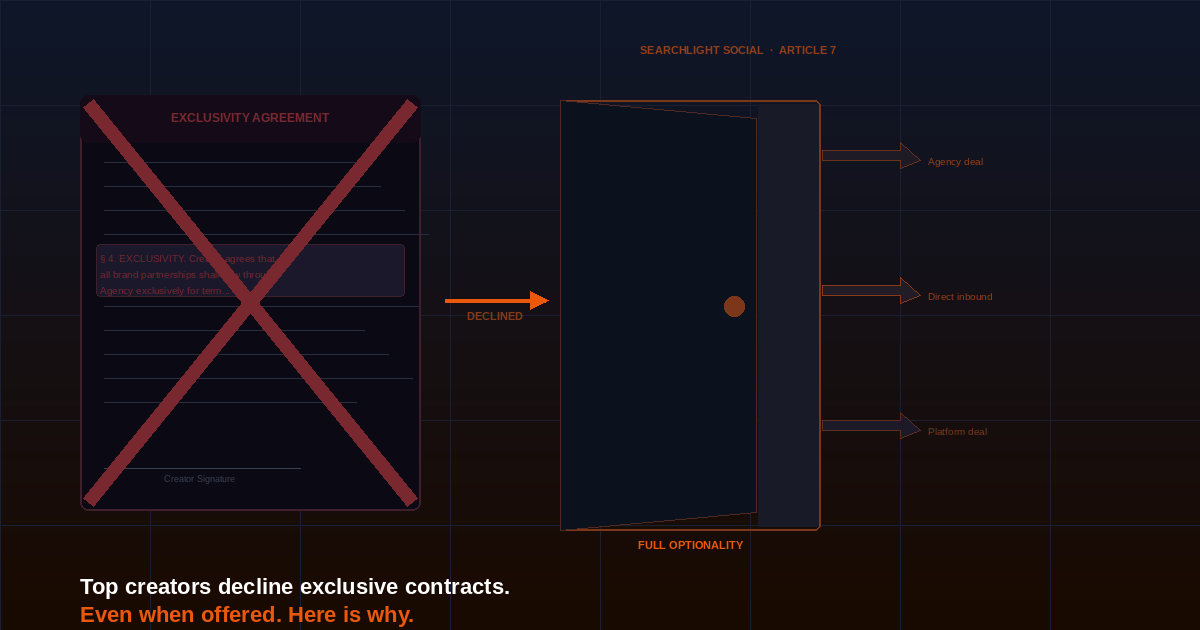
The most commercially sophisticated creators in the economy share one quiet practice that their peers do not understand: they decline exclusive influencer contracts, even lucrative ones. This is not accident or arrogance. It is the most important strategic decision they make.
An exclusive influencer contract is an agreement between a creator and an agency (or brand) that restricts the creator’s ability to work with other agencies or competing brands for a defined period. Agency exclusivity clauses require all brand partnerships to flow through the exclusive agency. Brand exclusivity clauses prevent the creator from working with competing brands in a specific category. The terms are used inconsistently in the industry; understanding which type of exclusivity is being offered in any specific agreement requires explicit clarification.
There is a pattern in elite creator careers that is visible only to those who understand the economics behind it. The creators consistently earning at the highest level — the ones whose partnerships are positioned most advantageously, whose rates keep improving, whose careers have built momentum rather than plateaued — share a specific practice. They decline exclusive influencer contracts with agencies. Even when the contracts come with attractive guarantees. Even when the agency offering them is prestigious. Even when their peers are signing similar agreements without apparent hesitation.
This is not accidental. It is not a negotiating tactic. It is the institutionalisation of something these creators have learned — sometimes expensively, through direct experience — about how exclusive contracts actually function over the medium and long term of a creator’s career.
Searchlight Social calls this instinct the Optionality Instinct — the pattern of behaviour in which commercially sophisticated creators systematically protect their ability to say yes to the right opportunities and no to the wrong ones, independent of any single relationship’s preferences.
“Elite creators do not avoid exclusive contracts because they do not want management. They avoid them because they understand the difference between management and restriction — and they refuse to pay for one disguised as the other.”
— Searchlight SocialA pattern of behaviour observed in commercially elite creators in which they systematically preserve deal flow optionality — the ability to pursue, accept, or decline any opportunity from any source — as the primary structural priority in their agency relationships. The Optionality Instinct is not anti-management. It is anti-restriction. Creators exhibiting it typically seek the highest quality professional management available while maintaining the freedom to operate across all deal channels.
- Selective agency use: Elite creators use agencies tactically — for specific campaigns, specific brand introductions, or specific markets — rather than structurally surrendering all deal flow to a single gatekeeper
- Direct brand relationships: The highest-value partnerships in most creator careers originate from direct brand relationships that cannot be maintained under exclusive agency arrangements
- Multiple-pipeline management: Rather than collapsing deal flow into one channel, elite creators maintain multiple active pipelines simultaneously with professional infrastructure applied to all of them
- Negotiating from abundance: Having multiple simultaneous conversations is the single most powerful negotiating advantage in creator deal-making — exclusive arrangements eliminate this advantage by design
Why exclusivity is accepted at the mid-tier and avoided at the elite level
The pattern of who accepts and who declines exclusive influencer contracts is remarkably consistent. Mid-tier creators — those building their careers and looking for the security that an exclusive relationship appears to offer — are the ones most likely to sign exclusivity arrangements. Elite creators — those who have already built their audience and understand their market value — are the ones most likely to decline them.
This pattern is not explained by the elite creators being more anti-establishment or more negotiating-savvy in a general sense. It is explained by experience. Elite creators have typically been through at least one exclusive relationship and have directly observed the ceiling it imposes. They have watched deals fall through because the exclusive pipeline could not service them in time. They have watched their peers in non-exclusive arrangements close opportunities they could not access. The Optionality Instinct is learned — usually through the specific, painful experience of a great opportunity that exclusivity made impossible.
For entertainment and media creators, gaming influencers, and finance creators — verticals where deal opportunities emerge quickly and time-sensitivity is high — the Optionality Instinct is especially prevalent because the cost of exclusive pipeline latency is especially visible.
What top creators do instead of signing exclusive agency contracts
Understanding what elite creators do instead of signing exclusive influencer contracts is more instructive than simply knowing they avoid them. They do not operate without management. They operate with non-exclusive management — sometimes formalised, sometimes informal, sometimes a combination of both.
The most common structure among elite creators involves a primary management relationship for strategy, high-stakes negotiation, and brand positioning — delivered by a partner who earns their position through performance rather than contractual lock-in. Alongside this primary relationship, the creator maintains direct relationships with specific brand contacts, active profiles on platform partnership programmes, and the ability to engage with third-party agencies sourcing for campaigns without contractual friction.
This structure is precisely what non-exclusive influencer management was designed to formalise and make available at every level of the creator market, not just the elite tier. The Searchlight Social influencer marketing management model delivers exactly this structure — management infrastructure without the lock-in that makes it necessary to earn before you can access it.
How to evaluate an exclusive contract offer you are actually considering
Not every exclusive offer is the wrong choice. The framework for evaluating a specific exclusive influencer contract offer requires three questions answered with specificity, not generality.
What is the guaranteed minimum? An exclusivity clause without a minimum deal guarantee is asking for restriction in exchange for potential. That is not an exchange — it is a commitment in one direction only. Any exclusive arrangement worth considering should include specific deal volume guarantees, not general representations of the agency’s intent to work hard on your behalf.
What is the exit provision? A contract you cannot exit within 90 days of notice is a long-term commitment, not an agency relationship. The best exclusive arrangements, where they genuinely deliver value, include performance-based exit provisions that allow either party to exit if the guaranteed minimums are not being delivered.
What is the Opportunity Friction cost? Using the Creator Independence Index, calculate your Dimension 3 score before and after accepting this arrangement. The reduction in deal origination control is a measurable cost — and it needs to be weighed against the guaranteed value this specific agency is committing to deliver. If the math does not work in your favour, the instinct to decline is the correct one.
The management model that top creators already operate on
Searchlight Social institutionalises the Optionality Instinct — professional influencer management without the exclusive influencer contract that caps what you can do with it. Our influencer coaching and consultant teams build the architecture that elite creators operate on. Verified on Google.
Work with Searchlight SocialFrequently asked questions: exclusive influencer contract
An exclusive influencer contract can refer to two different types of exclusivity. Agency exclusivity requires all brand partnerships to flow through a single agency — the creator cannot accept deals from other agencies or directly without the exclusive agency’s involvement. Brand exclusivity is a campaign-level clause preventing the creator from working with competing brands in a specific category for a defined period. Agency exclusivity is structural and affects the creator’s entire business. Brand exclusivity is campaign-specific. Creators are often offered both simultaneously within the same contract.
Generally, the burden of proof for signing an exclusive agency contract should be high. The arrangement is worth its restriction only when the exclusive agency can demonstrate specific, measurable advantages — guaranteed deal volume, unique brand relationships, verified revenue track record — that exceed what non-exclusive management would produce. For most creators, that case cannot be made credibly. The default assumption should be that non-exclusive management is the better structural arrangement unless a specific exclusive offer can prove otherwise with concrete guarantees.
The Optionality Instinct is Searchlight Social’s framework describing the pattern of behaviour in which commercially elite creators systematically decline exclusive influencer contracts and instead maintain multi-pipeline deal flow with professional management applied across all channels. The instinct is not anti-management — elite creators actively seek high-quality management. It is anti-restriction: the recognition that exclusivity caps career earnings, reduces negotiating leverage, and eliminates the optionality that produces the best long-term career outcomes.
The direct cost of an exclusive agency contract is the commission on agency-sourced deals — typically 15–20%, similar to non-exclusive arrangements. The hidden cost is the Opportunity Friction: the cumulative impact of lost or delayed deals from non-agency channels, reduced negotiating leverage from pipeline dependency, and the ceiling on total deal volume imposed by single-pipeline architecture. Over a three-to-five year career trajectory, this hidden cost typically exceeds the direct commission cost significantly — often representing 30–60% of additional income that was structurally unavailable due to exclusivity restrictions.
Three non-negotiable provisions: a guaranteed minimum deal volume that makes exclusivity mathematically worth the Opportunity Friction cost; a performance-based exit clause that allows exit within 90 days if guarantees are not delivered; and explicit specification of which channels and deal types are covered by the exclusivity restriction — because “all brand partnerships” is not the same as “brand partnerships in categories X and Y sourced by third-party agencies.” Any exclusive contract that cannot provide all three provisions with specificity should be treated as an agency’s interest presented as creator protection.
Related reading
Searchlight Social is a Los Angeles-based influencer management agency and influencer marketing agency managing over 1 billion views globally on a non-exclusive model. Our influencer consultants, influencer coaching specialists, and social media coaches build creator careers designed for long-term growth. Verified on Google Business →
Discover more from SearchLight Social
Subscribe to get the latest posts sent to your email.