 Skip to content

By Vince Dwayne, CEO | April 2025 | 12-min read
Fashion influencers are not selling clothes.
This is the sentence the fashion industry does not want to hear, because it has spent the better part of a century building a machine predicated on the idea that clothes are what people want. They are not. What people want is permission — permission to occupy an identity they have not yet tried, permission to believe that a certain version of themselves is available to them, permission to dress in a way that feels true to who they are becoming rather than who they have been.
The influencer who understands this is not in the fashion business. They are in the identity business. And those are governed by completely different rules.
What Actually Happens When Someone Watches a Fashion Creator
The conventional account of how fashion content works goes something like this: viewer sees outfit, viewer desires outfit, viewer purchases outfit, or follows the creator for more outfits. This is the logic that drives most fashion brand briefs, most creator briefs, and most of the advice given to emerging fashion creators.
It is also wrong, or at least so incomplete as to be misleading.
Here is what is actually happening: a viewer encounters an outfit they would never have considered wearing, and the primary response is not “I want that.” It is “Could someone like me wear that?” They are not evaluating the clothes. They are negotiating their identity in real time, using the creator as a proxy. The creator is standing in for the version of the viewer who has already made the leap — who has already decided they are the kind of person who wears that.
This is why the most powerful fashion content is rarely about the clothes themselves. It is about the person wearing them, and the confidence, the context, the casualness with which they inhabit them. When a creator pulls on a blazer while explaining something else entirely, the viewer receives a message that no brand can purchase: wearing this is easy, natural, available, and no special occasion required. It does not demand that you become someone different. It invites you to become more specifically yourself.
The French have a word for this — désinvolture — an easy, unstudied elegance that signals comfort in one’s own skin. Fashion influencers who project it are granting something. Those who don’t are simply modelling.

The Aspiration Trap and Why the Fashion Industry Keeps Falling Into It
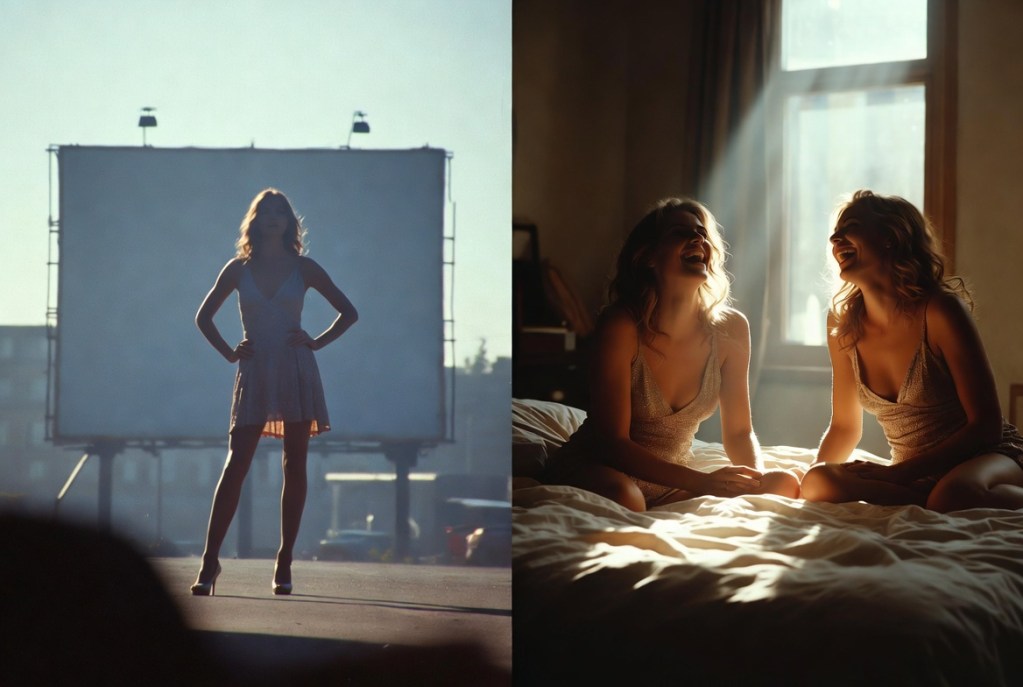
The fashion industry’s default register is aspiration. Make it beautiful, make it remote, make it feel like a world the viewer might one day be admitted to. This logic was built for print media, for billboards, for television advertising — for one-way broadcast relationships where the viewer had no mechanism to get close to the image.
Creator media inverts this entirely.
The closer a viewer gets to a creator — through daily Stories, through comment replies, through the accumulated intimacy of hundreds of pieces of content consumed over months — the more aspiration reads as distance. An aspirational fashion influencer is, by definition, someone you are watching from across a gap. And the longer you watch them from across that gap, the more clearly you understand that the gap is the point. You are not supposed to get there. You are supposed to keep wanting to.
This works for selling fragrance in a magazine. It does not work for building a loyal creator audience. Because a loyal audience is not made of people who watch you from a distance. It is made of people who feel that you are specifically for them — that your taste, your body, your budget, your specific relationship with clothing speaks to something in them that nobody else is speaking to.
The fashion influencers with ten-year careers are not the most aspirational. They are the most specific. They have a particular relationship with clothes — playful, serious, archive-obsessed, deeply practical, aggressively sustainable, quietly luxurious — and they inhabit it so completely that a community of people who share that relationship has no one better to follow.
What Brands Are Actually Buying (And Getting Wrong)
When a fashion brand partners with a creator, the brief almost always describes the goal as “reaching a fashion-conscious audience.” This framing is so broad as to be commercially useless, and we see its consequences constantly in our work at Searchlight Social: partnerships that deliver impressions without conversions, follower counts without purchase intent, awareness without trust.
What fashion brands are actually buying — when the partnership works — is not to reach into a “fashion audience.” Fashion is too diffuse a category to be useful. What they are buying is access to a specific aesthetic community: a group of people who have self-selected into a particular philosophy of dressing, curated by this specific creator’s specific identity over time.

A creator who has built an audience around “practical luxury on a teacher’s salary” is not interchangeable with one who has built an audience around “post-internet archive maximalism,” even if their follower counts are identical. The first audience has a specific income bracket, a specific relationship between aspiration and constraint, and a specific purchasing behaviour pattern. The second has almost none of those things in common with the first. They are different aesthetic communities. They respond to different products and they represent different commercial opportunities.
The brands that get fashion creator partnerships right understand which aesthetic community they are trying to reach before they identify which creator reaches it. The brands that get it wrong start with the creator’s follower count and work backward. This is why the influencer marketing ROI data in fashion is so inconsistent: the variable is not the creator’s audience size. It is whether the brand’s product belongs inside the creator’s specific aesthetic community.

The Four Ways Fashion Content Fails
The curation-without-perspective failure. The creator has taste — real taste, evident taste — but no opinions. The outfits are excellent. The captions are empty. The viewer admires and moves on because there is nothing to attach to. Taste without perspective is a mood board. It is not a person. And audiences follow people, not mood boards.
The trend-chasing failure. The creator moves from microtrend to microtrend, always current, never coherent. Over time, the audience does not know what this creator stands for — only what they wore this week. Without a legible aesthetic identity, there is nothing for the audience to self-select into. The follower count may grow. The conversion rate and the loyalty do not.
The product-without-person failure. The creator produces technically excellent content — good lighting, good photography, good styling — but the person inside the clothes is absent. Fashion content without personality is a catalogue. It may drive product awareness. It will not drive the kind of trust that builds careers or commands brand premiums.
The aspiration death spiral. The creator builds an audience on a highly aspirational register — designer pieces, remote locations, unattainable production values — and then finds it impossible to sustain. When the reality inevitably shows through, the audience does not empathise. They disengage, because the contract was aspiration, and the creator has broken it. The aspirational register is expensive to maintain and fragile to own. The specific, personal register is cheap to maintain and almost impossible to displace.
Where Fashion Influencing Is Going
The saturation of fashion content — the endless OOTDs, the try-on hauls, the seasonal wardrobe tours — is producing a predictable audience response: fatigue with the content and a recalibration toward creators who offer something more than clothes.
The fashion influencers who will define the next decade are building what we would call aesthetic philosophies rather than aesthetic identities. An aesthetic identity answers: what do you wear? An aesthetic philosophy answers: what do you believe about clothes, and why? The second question is more interesting, more durable, and more differentiated. It is also the question that produces the content audiences share, save, and return to — because it is, at its root, a question about values, not trends.
The question that follows is harder. In a landscape flooded with AI-generated styling content, with algorithmic trend prediction that makes the fashion cycle nearly frictionless, the differentiator will not be the creator who knows what is trending. It will be the creator who knows why certain things last — and who has built an audience that trusts their judgment about that, across time, through the evolution of their own relationship with clothing.
That creator cannot be replicated. A trend report can. A philosophy, earned through years of specific, honest content, cannot.
The Practical Implications
Fashion content that moves the needle on what actually matters — loyalty, trust, commercial value — is built on the following logic:
Before you create, the question is not “is this on trend?” It is “Does this express something true about my relationship with clothes right now?” The former produces content that dates in ninety days. The latter produces content that compounds.
Your outfit posts are not catalogues. They are arguments. Why this? Why now? How does it work in combination with that? What does the combination express that no single item could? A creator who makes those arguments explicitly, in captions and in videos, is offering something that no retailer and no algorithm can provide: a point of view that the viewer can borrow while they develop their own.
Your brand partnerships should be chosen as aesthetic arguments, not income opportunities. Every product you endorse is a statement about what you believe belongs in the aesthetic community you have built. One wrong partnership — a brand that doesn’t belong in your world — costs more in trust than it pays in fees. We have watched this happen enough times that we now consider it the single greatest commercial risk in a fashion creator’s career.
Your community is not your audience. It is an aesthetic group that has coalesced around your specific identity. Treat it accordingly — with editorial consistency, with respect for its collective taste, and with the understanding that they are not following you to see what is new. They are following you to stay connected to a particular way of seeing and being dressed.

A successful fashion influencer has a legible, specific aesthetic identity that functions as an invitation to a particular kind of audience — not broad appeal, but precise resonance with a defined community. Consistency of aesthetic identity over time matters more than consistency of posting frequency.
The deeper truth: the word “successful” in this context almost always conflates reach with commercial value, and they are not the same thing. A creator with 80,000 followers and a tightly cohered aesthetic community will consistently outperform a creator with 800,000 followers and a trend-chasing approach, when measured against the metrics that actually matter to brands: conversion rate, repeat purchase, and comment engagement on product moments.
Growth on Instagram for fashion creators comes from aesthetic consistency, strong hook imagery in the first frame, and content that gives the audience something to identify with rather than simply admire.
The mechanism most growth advice misses: the fastest-growing fashion creators are not the ones making the most beautiful content. They are the ones making content that a specific audience feels is specifically for them. The share is the primary growth mechanic on Instagram, and people share fashion content when it reflects an identity they want to claim publicly. If your content could be shared by anyone, it will be shared by no one in particular.
Brands look for aesthetic alignment between their product and the creator’s established aesthetic community, engagement quality over follower quantity, and evidence that the creator’s audience makes purchasing decisions based on their recommendations.
What brands are increasingly measuring, and what most creators don’t know to optimize for: the comment behaviour around product moments specifically. “Where is this from?” in a comment is worth more than a thousand passive views. Brands with sophisticated influencer programmes track this metric per creator and use it to calculate a real-world conversion signal that no third-party analytics platform can provide.
Often enough to maintain aesthetic presence in your audience’s feed; not so often that the content becomes reflexive rather than considered. For most fashion creators, three to four pieces of considered content per week outperforms seven pieces of rushed content — because fashion audiences are curators themselves, and they are sensitive to the difference between content that was thought about and content that was produced.
Fashion content is oversaturated. Fashion creators with a specific point of view are not. The distinction matters enormously. The search is not for more fashion content — there is more fashion content than anyone can consume.
The demand that is consistently unmet is for a creator whose specific relationship with clothes reflects something true about the viewer’s own experience. That demand is permanent and structurally impossible to fully satisfy.
Almost always one of three reasons: the content is admirable but not identifiable — viewers appreciate it but don’t see themselves in it; the aesthetic is inconsistent enough that there is no coherent identity to self-select into; or the hook — the first frame — is not doing enough work to stop the scroll before the outfit can be evaluated.
The hardest diagnosis to hear: if your content looks like content that belongs on a brand’s Instagram rather than a person’s, it will perform like brand content — generating awareness but not connection. The corrective is not better production values. It is more of you, more specifically, inside the clothes.
Searchlight Social is a premier influencer agency specialising in talent management, brand partnerships, and content strategy across beauty, fashion, and lifestyle.
Discover more from SearchLight Social
Subscribe to get the latest posts sent to your email.