 Skip to content

Creator Strategy / Creator Business
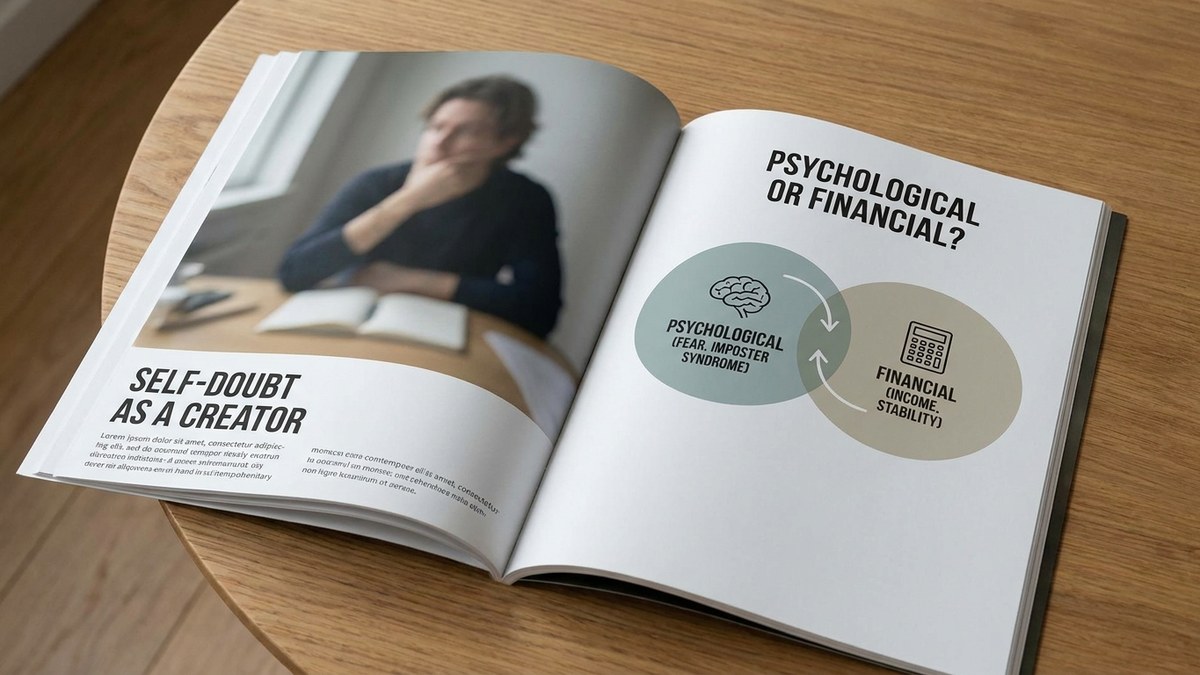
Self-Doubt as a Creator: Psychological or Financial?
The question gets treated as a confidence problem. Most of the time it is a measurement problem wearing a confidence costume.
Self-doubt as a creator is framed psychologically and is usually informational. Asking whether to keep investing in your craft is a business question with no available evidence to settle it. Creator feedback is noisy, delayed and unbenchmarked. In that vacuum the question mutates into “am I good enough,” which has no answer. Sometimes the doubt is also correct and the investment is a bad one.
Searchlight Social coaches creators in Los Angeles, New York, and Chicago.
We are a coaching-first, non-exclusive influencer management agency based in Simi Valley, California. Verify us on Google Business Profile.
Disclosure: Searchlight Social sells coaching. When I write about whether creators should invest in themselves, I am one of the people they would be investing in, and you should weigh what follows accordingly. I am also not a clinician, and nothing here is health advice. Where I note that imposter syndrome is not a formal diagnosis, that reflects published material on the term, which was introduced by psychologists Clance and Imes in 1978.
Who answers creator self-doubt questions
I searched for what creators find when they look this up, and the result was uniform enough to be worth reporting.
Almost every piece of advice about creator self-doubt is published by somebody selling a course, a coaching programme, or a training in how to coach people with self-doubt. The recommended remedy in nearly every case is to invest in yourself, which is also the product being sold on the same page.
That is not evidence they are wrong. It does mean the entire available literature on whether to spend money on your development is written by the people receiving the money, which is a poor evidentiary situation for anyone trying to decide.
Why creator self-doubt never resolves
The Unanswerable Question
The recurrence is a clue that something is wrong with the question rather than with the person. The Unanswerable Question is the reframing of a business assessment as a judgment of personal worth, in which “is this returning on what I put in” becomes “am I good enough,” a version that has no test attached and therefore cannot be settled by any amount of evidence.
Watch what happens to each version. Give a creator a strong month and the business question is answered for now. Give the same creator a strong month while they are asking whether they are good enough, and it becomes luck, or the algorithm, or a fluke. Nothing counts, because the question was never constructed so that anything could count.
This is why affirmation does not work and why people who receive plenty of it still ask. The problem is structural. You cannot resolve a question that has no evidence condition, and most creator self-doubt is exactly that shape.
Why creator self-doubt is a reasonable response
The Verdict Gap
What makes this different from ordinary professional insecurity is that the uncertainty is real. The Verdict Gap is the distance between doing creative work and receiving evidence that can be interpreted, produced by high variance between posts, delays of months in commercial outcomes, and the absence of reliable benchmarks, so that a creator often cannot tell from the available data whether their work is improving.
Consider what a creator has to work with. Individual post performance varies enormously for reasons unrelated to quality. Brand income arrives a quarter after the work that generated it. And the industry benchmarks that would tell them whether their numbers are good come from vendors who disagree with each other by margins large enough to reverse the rankings.
A person in that position who feels uncertain is not being irrational. They are responding correctly to uninterpretable information. The remedy is measurement rather than reassurance, and reassurance is what the market sells.
| The doubt as felt | The version with an answer |
|---|---|
| Am I good enough at this? | Is your annual median higher than last year? |
| Should I keep going? | What does an hour of your time return, and against what alternative? |
| Is it worth investing in myself? | Which specific weakness would this spend fix? |
| Does anyone care what I make? | What is your return rate on the last twenty posts? |
| Am I falling behind? | Behind whom, on which measure, and does it pay? |
Every row on the right can come back as no, which is the point. A question worth asking is one that could disappoint you.
When self-doubt about spending is correct
The Four Investments
What creators spend on, and what each tends to return.
Buying time
An editor, an assistant, anything that returns hours. The most reliably positive spend available, because it directly increases the output of your content, which is the thing already working.
Verdict: usually right, and usually made too late.
Fixing a named weakness
You know your openings are weak, or your negotiation is, and you buy help with that specific thing. Narrow, testable, and the outcome is visible within weeks.
Verdict: often right, provided the weakness was named before the purchase.
Equipment upgrades
Almost never the constraint. Creators buy cameras when their retention graph says the problem is the first two seconds, which no lens has ever fixed.
Verdict: usually the doubt is correct. Do not spend.
General courses and confidence programmes
Broad, unbounded, no defined outcome. If you cannot state what will be different in eight weeks and how you would know, the doubt about buying it is doing its job.
Verdict: the doubt is frequently right, and this is the category most heavily marketed at doubting people.
That last card is where I have to be careful, because it describes an adjacent version of my own business. The distinction I would defend is between help attached to a named problem with a visible outcome, and help sold against a feeling. The first is a service. The second is comfort, and comfort priced as development is the thing to be suspicious of.
So which is it, psychological or financial?
Both, in a specific order. It starts as a financial question, becomes psychological when no evidence is available to settle it, and then gets sold back to the person as a psychological problem with a paid solution.
Breaking that sequence does not require confidence. It requires converting the question into something that can return an answer, then accepting the answer when it arrives, including when the answer is that a particular spend is not worth making or that the return on an hour is currently poor.
Creators who do this are not more self-assured than anyone else. They have simply stopped asking a question that cannot be answered and started asking three that can.
When self-doubt is not a business problem
Everything above is about a business decision, and there is a version of this that is not a business decision at all.
Persistent low mood, a sense of worthlessness that does not respond to good outcomes, or doubt that has stopped tracking anything happening in your content is a different thing from an unresolved commercial question, and reframing will not touch it. That belongs with a professional rather than with an agency owner, and it is worth saying plainly rather than leaving implied.
Worth noting too that the term most often reached for here, imposter syndrome, is not a formal diagnosis. It is a widely recognised description, reported by a large majority of professionals at some point, and it has become a commercial category. That does not make the feeling less real. It does mean that when someone offers to cure it for a fee, the thing being sold is not treatment.
What good coaching looks like here
I said above that most advice on this is sold by people who get paid when you say yes. That includes me, so let me be plain about what would make it worth your money.
Good coaching gives you something you can check. Your median against last year. Your retention at two seconds. What an hour of your time earns. If nobody can hand you a number that might disappoint you, you are buying reassurance, and reassurance is not worth paying for.
That is the bar we hold ourselves to. Our methods are published in the Searchlight Method so you can read them before you decide.
Questions creators ask about self-doubt
Is creator self-doubt psychological or financial?
It typically begins as a financial question about whether the work returns on the effort, becomes psychological when no evidence is available to settle it, and is then sold back to the creator as a confidence problem with a paid remedy. The underlying issue is usually measurement rather than mindset.
Why doesn’t reassurance fix creator self-doubt?
Because “am I good enough” has no evidence condition attached. A strong month gets attributed to luck or the algorithm, since the question was never built so that anything could count as an answer. Converting it into a measurable version, such as whether the annual median has risen, gives it something to resolve against.
Is it worth investing in courses or coaching as a creator?
It depends on whether the spend is attached to a named weakness with a visible outcome. Buying help with a specific problem you identified beforehand is testable within weeks. Broad confidence programmes with no defined outcome are the category most heavily marketed at doubting people, and doubt about them is often warranted.
What is the most reliable thing for a creator to spend money on?
Time. An editor or assistant returns hours directly to the work already generating income, which makes it the most consistently positive spend available. Equipment is rarely the constraint, since retention problems in the opening seconds are not solved by better cameras.
Is imposter syndrome a real condition?
The feeling is real and widely reported, but the term is not a formal diagnosis. It was introduced by psychologists in 1978 and has since become a commercial category. Persistent low mood that does not respond to good outcomes is a different matter and worth discussing with a professional rather than a business adviser.
Ask the version that can be answered
Searchlight Social coaches creators on measurement and business decisions, starting from what your numbers can and cannot tell you.
Searchlight Social
2880 Cochran St #1109, Simi Valley, CA 93065
+1 (805) 850-3103 · info@searchlightsocial.com
Serving Los Angeles, New York, and Chicago · Google Business Profile · Contact
Discover more from SearchLight Social
Subscribe to get the latest posts sent to your email.