 Skip to content

14 Ways to Fix Your Instagram Reach and Algorithm Identity in 2026
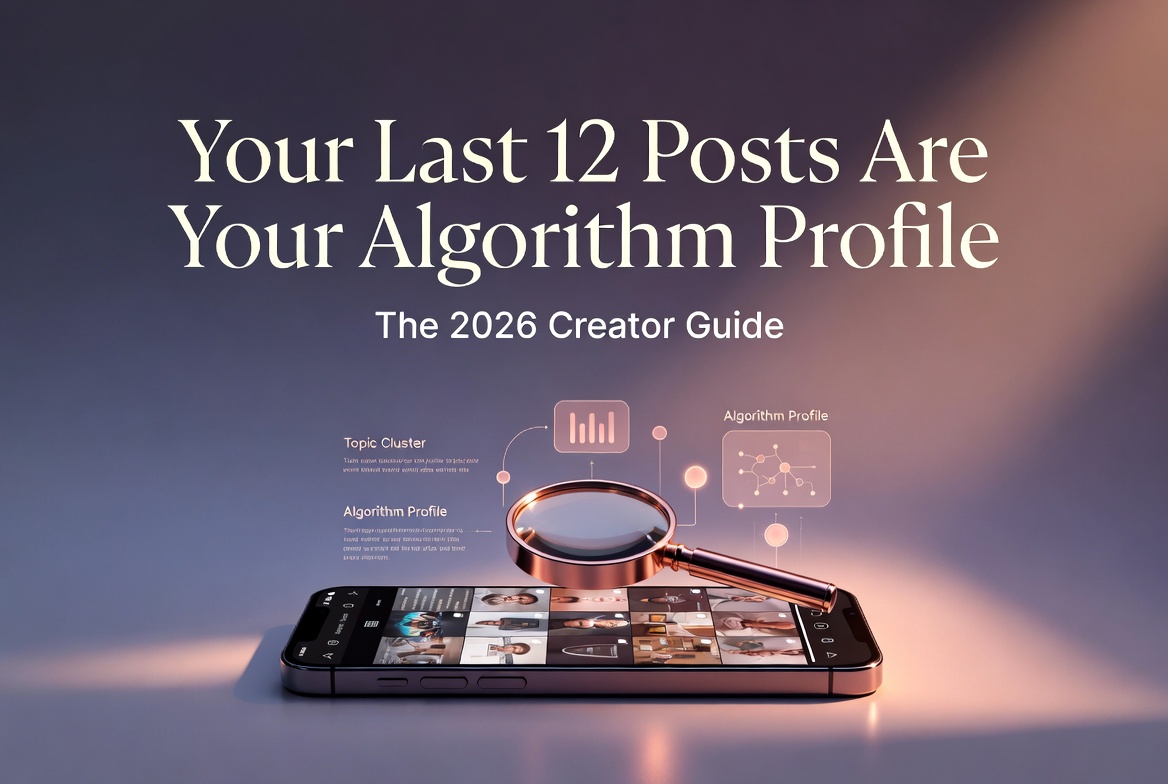
The algorithm has amnesia. It no longer evaluates your content purely individually. Instead, it reviews your last 9 to 12 posts as a single window to decide what your account is about, who should see it, and whether your distribution lives or dies.
Go open your Instagram profile right now. Scroll past the bio, past the highlights, and look directly at your grid. Those first twelve posts—the twelve most recent pieces of content you have published—are not just standalone uploads. They are a single diagnostic document. A file the system reads continuously to determine exactly who you are, what you make, and who should see it.
Most creators have never looked at their grid as a collective piece of data. When they do, what they find explains why their reach is dropping: a mixed-content pattern that makes their account nearly impossible for Instagram’s AI to classify and recommend. Confused algorithms don’t distribute content. If the core platform structures lose clarity on where to place you, distribution gets throttled before it even reaches your own followers.
“Your most recent 12 posts are your algorithm profile. They matter more than your follower count, your posting history, or your account age. The algorithm has amnesia, and it only responds to current evidence.”
— Searchlight SocialWhy Is My Instagram Reach Dropping in 2026?
Instagram’s content graph operates on a principle that catches many established creators off guard: recency entirely dominates history. The platform does not reward historical positioning; it rewards real-time authority. The mechanism works through Topic Cluster Assignment, which groups creators into highly refined algorithmic interest communities.
When you post, the recommendation system needs to resolve one primary question: Who is this creator, and which specific target groups are most likely to stick around for this content? To answer this, it reviews your rolling identity window. The rest of your profile history—the months you spent building initial authority, the consistency you maintained a year ago, or the viral breakout that netted you 10,000 followers—carries effectively zero weight in current recommendation feeds.
While Instagram doesn’t explicitly publicize an exact numerical boundary, platform engineering metrics, consumer-facing adjustments, and creator data track perfectly to a rolling window of 9–12 posts. This is also the operative database matrix utilized by the transparency updates launched in late 2025. If your recent posting window presents a fragmented data output, your topic cluster classification breaks down entirely.
This reality feeds directly into the Follower Liability Effect. When your topic cluster shifts or splinters, your newly published content is displayed to the wrong audiences. Because they have zero interest in that specific update, they produce incredibly weak engagement signals. The algorithm registers this underperformance as a signal of low content quality, suppressing further distribution across the board.
The 5 creator profiles whose last 12 posts are destroying their reach
These five distinct account patterns represent the most frequent architectural failures analyzed by Searchlight Social when auditing declining creator reach. If your views have stagnated, you are likely suffering from one of these profiles.
You built your account on a clear niche—fitness, food, personal finance—and it worked. Then you evolved, shifted, or simply shifted your focus, and your last 12 posts reflect a completely different vertical. To the algorithm, you have abandoned your cluster. You are now entering an entirely new niche with zero baseline authority, competing against entrenched players. Your legacy audience scrolls past the new topic, while the new topic cluster algorithm hasn’t developed enough data confidence to push you out to broader non-follower feeds. You are trapped in the classification gap.
Life happened. A period of severe burnout, a major health scare, or an intense personal transition meant that the only updates you could manage were deeply personal vlogs or casual video journals completely unrelated to your typical business or education content. While your core community offered emotional validation, the AI didn’t see empathy—it saw a professional account suddenly outputting completely different contextual keywords. It reclassified your account cluster. Weeks later, your reach remains suppressed because the system is treating you as a brand-new identity.
You executed a massive trend or a generalized comedy piece that exploded. You gained 8,000 followers in a weekend. However, those new additions followed purely for that isolated format—they don’t care about your actual core niche. Now, when you return to your true content, this massive segment of disengaged followers acts as a weight. The system tests your new post with them, they ignore it, and the system assumes the content is low-tier, killing its distribution waterfall.
Motivational quotes on Monday, a recipe on Wednesday, a tech tip on Friday, and a travel vlog on Sunday. You believe that complete lifestyle variety keeps people intrigued, but your last 12 posts tell an AI that you lack an operational identity. Because it cannot confidently map you to a defined consumer target, it distributes your media across five distinct clusters incredibly weakly, rather than dominating a singular profitable community.
You feel incredibly consistent because you haven’t stopped posting entirely, but a closer look reveals severe thematic erosion. A casual screenshot here, an off-topic life update there, and a brand promotion unrelated to your niche scattered throughout. By the time you return to your intentional strategy, your 12-post window is a diluted blur. No individual upload broke the rules, but the systemic pattern destroyed your structural positioning.
The 14 Algorithmic Fixes for Immediate Reach Recovery
Fix 1: Do the 15-Minute Grid Audit Before Posting Anything Else
Stop uploading content immediately. Before attempting any structural changes, take a screenshot of your profile’s top 12 posts and analyze them on one screen. Treat them like an open dossier. If a complete stranger stumbled upon this document without reading your bio, could they determine your exact, hyper-specific industry in under 10 seconds? If the answer is no, your algorithm profile is broken.
Fix 2: Tag Each Post By Its Literal Topic, Not Your Intention
Review each of your last 12 uploads and attach a blunt, single-word label representing its literal content—not your high-level strategy. A casual morning vlog is lifestyle, a workout session is fitness, a quote screenshot is motivation, and a tactical tutorial is business. Count the unique tags. If you find three or more completely distinct themes with no unifying through-line, your topic cluster is fragmented, directly explaining your reach suppression.
Fix 3: Identify and Track the Cluster-Breaking Outliers
Locate the specific post entities that broken your theme consistency. A cluster-breaker sitting in positions 1–3 (your most recent uploads) is an immediate crisis, as it holds maximum algorithmic weighting. A breaker down in positions 10–12 is slowly rotating out of the system’s core memory. Note if the outlier went viral for the wrong reasons; if it did, it likely pulled in a highly detached audience segment that is actively working against your future engagement benchmarks.
Fix 4: Optimize for the 2026 “Your Algorithm” Feature
In December 2025, Instagram deployed the user-facing “Your Algorithm” command dashboard (Settings → Content Preferences). This allows everyday consumers to review the exact interest categories the AI has tagged onto their profiles and explicitly delete the topics they no longer wish to see.
Niche precision is now a functional survival requirement. If your rolling 12-post document causes the system to place you in a tangential, messy, or low-value category, one single tap from a user can wipe your brand out of their recommendation ecosystem forever.
Fix 5: Select 2-3 Hyper-Specific Interconnected Pillars
Define your destination topic cluster before touch the camera again. Avoid generic category headings like “wellness” (unmanageably broad) or extreme sub-niches like “winter morning yoga for corporate remote workers over 40” (too narrow for efficient machine categorization). Choose a targeted, highly recognizable tier. Use the classic creator stress test: Can you comfortably draft 50 unique conceptual angles for this exact focus right now? If yes, commit to it.
Fix 6: Shift Metrics to the 2026 Engagement Value Hierarchy
If your team is still celebrating simple likes, you are tracking data that the algorithm has largely deprecated. To drive high-velocity non-follower reach, you must optimize your content structures according to the modern platform value hierarchy:
- Tier 1
DM Shares (The Ultimate Discovery Signal)
When an individual forwards your post via DM to a peer, the AI views it as a definitive, high-trust endorsement. Data indicates that 694,000 Reels are shared via DM every single minute. Globally, one DM share heavily outweighs standard public engagement metrics.
- Tier 2
Saves (Long-Term Informational Utility)
Saves explicitly verify deep structural value. Actionable step-by-step blueprints, checklists, proprietary frameworks, and tutorial playbooks command saves. Fleeting trends rarely do.
- Tier 3
Watch Time & Retention Metrics
Retention charts are vital for automated scale. A detailed 30-second video that holds an viewer’s focus for 20 seconds will systematically outperform a shallow 7-second looping trend clip because it retains user attention on the platform longer.
- Tier 4
Substantive Paragraph Comments
Replies that extend beyond 5–6 words read as genuine social relevance within semantic processing engines. Monosyllabic statements or isolated emojis hold minor contextual value.
- Tier 5
Caption Dwell Time & Profile Clicks
The time spent reading an expanded, highly educational caption acts as an organic quality indicator. Craft valuable written assets alongside your visual components.
Fix 7: Analyze the Content Models of Top Creators
The dominant accounts across the creator economy do not succeed on sheer volume; they scale on total clarity of message. Pick any 12 grid blocks from their profiles at random, and they will consistently output the exact same topical signature:
Clarity Frameworks of Entrenched Accounts
- Khaby Lame: Built an empire on a singular mechanical joke structure. Every single piece of content maps to the exact same predictable theme, turning external pop-culture trends into immediate algorithmic fuel.
- Huda Kattan: Maintains absolute dedication to the beauty and cosmetics vertical. Product training, unfiltered testing, and industry tips populate her feed. The recommendation engines never have to guess who her assets are for.
- Duolingo: Weaponizes a concrete, comedic character identity that turns real-time trending cultural moments into brand-aligned video assets within hours, keeping engagement rates exceptionally high.
Fix 8: Deploy the Gold-Standard Format Distribution Mix
Different surfaces across the application run on completely different discovery systems. To ensure top-tier health, balance your production output across these precise ratios:
60% Reels (specifically optimized for non-follower discovery and new cluster authority), 20% Carousels (engineered to drive deep saves, caption dwell time, and immediate carousels re-surfaces), and 20% Stories (strictly dedicated to nurturing your existing, locked-in audience segment rather than driving cold reach).
Fix 9: Format Captions for Semantic Search Engine Optimization
In-app search mechanics operate as search engines. Consumers actively use natural syntax string phrases to locate topical media (“budget backpacking Japan,” “no-equipment leg home workout”). Craft long-form, highly informative captions embedded with the precise terminology your ideal target profile searches for. The semantic AI parses these text files to properly align your asset’s category positioning.
Fix 10: Structure an Immediate Visual Pattern Interrupt
When your video enters the initial testing phase with a non-follower sampling audience, the first 3 seconds dictate the clip’s entire lifecycle. You must build an explicit opening sequence: a strong pattern interrupt in the initial 0.5 seconds (unexpected angles, continuous movement, or an unconventional transition), immediately backed by a spoken or textual thesis statement, leading directly into immediate narrative tension or a creative loop hook.
Fix 11: Maintain a Consistent Posting Cadence
Frequency requirements are not about hitting an arbitrary daily quota; they are about maintaining consistent data signals within the rolling evaluation window. Publishing 3–5 times per week has been shown to generate double the baseline audience growth compared to inconsistent schedules. If your brand can only deliver 2 top-tier, highly informative videos a week, lock that schedule in. Quality consistency prevents the platform from lowering your distribution prioritization scores.
Fix 12: Capitalize on Initial Engagement Velocity
The initial 60 minutes after clicking publish serve as a critical diagnostic phase. The network monitors early engagement velocity—how fast your asset accumulates shares, saves, and comments from active users. Open your in-depth audience analytics tab, isolate the specific hour windows where your current consumer base is highly active, and deploy your content 15 minutes prior to that peak point to capture immediate momentum.
Fix 13: Implement the 4-Week Cluster Recovery Framework
If your audit reveals significant niche drift or structural fragmentation across your grid, do not panicking. You can completely shift your automated placement parameters within a few weeks of deliberate, targeted content deployment.
Commit fully to your 2–3 core pillars. Stop publishing entirely if necessary to plan your content assets. Ensure every piece of content planned for the coming weeks has a clear, unmissable theme that any casual user could recognize instantly.
Publish 4–6 highly optimized, premium core posts. Zero experimentation, zero off-topic updates, and zero casual life stories. Every upload must clearly define your niche. Each addition systematically rotates old, off-topic content out of your active 12-post window.
With your primary topic cluster established on your grid, you can safely integrate a complementary sub-pillar. A fitness brand introducing a targeted nutritional overview is a natural extension; introducing real estate tips is a structural break.
Review your detailed post insights, filtering specifically for “Accounts Reached: Not Following.” An upward trend here proves that the recommendation system has successfully re-indexed your account profile and is driving targeted discovery reach.
Fix 14: Stop Deleting Your Historic Content—Archive Instead
One of the most damaging actions a creator can take during a reach crisis is mass-deleting old, off-topic posts in an attempt to clean up their feed. This backfires completely. The algorithm tracks forward-looking indicators; deleting old posts does not retroactively change your current cluster assignment or repair a damaged engagement benchmark.
Mass deletion strips away historical data signals from your profile, which can lead the system to flag your account for suspicious activity. If an older asset contains genuinely outdated information, simply use the Archive tool. Otherwise, focus all your energy on optimizing your upcoming uploads to rotate older content out of the active window naturally.
Struggling to Break Out of an Algorithmic Reach Slump?
This is exactly what Searchlight Social’s dedicated programs are built for. As a full-service influencer management agency, our elite team of social media coaches and influencer consultants works directly with global creators and enterprise brands to build crystal-clear positioning profiles that turning unpredictable algorithmic drops into reliable, scalable growth paths.
Book a Strategic Coaching SessionFrequently asked questions: your last 12 instagram posts and your algorithm profile
Yes. The platform relies on a rolling window of your 9–12 most recent posts to calculate your active Topic Cluster Assignment. While your complete account history remains in the database, recommendation surfaces like the Reels feed and Explore rely entirely on this real-time window to ensure content matches current user interests. The system prioritizes immediate proof over historical authority.
When you begin posting content outside your established theme, the account enters a transitional reclassification phase. Because the system’s confidence level drops, it matches your content with lower-priority test groups, resulting in weaker initial reach. At the same time, your existing followers may ignore the new topic, creating a temporary drop in engagement metrics that typically lasts 2–4 weeks until your new cluster authority is established.
No. Deleting old posts does not clear your historical account health metrics or automatically reset your classification. The most effective approach is a forward-focused content strategy. By uploading new, highly optimized thematic posts, you naturally push old, off-topic content out of the active 12-post evaluation window.
Most accounts see a clear turnaround in discovery reach within 3–4 weeks of consistent, on-theme publishing. However, if your account is recovering from a major mismatched audience event (such as an accidental viral post outside your niche), rebuilding your engagement baseline can take anywhere from 6–8 weeks of strategic posting.
Yes, but only if those topics fit into a single, cohesive master category. For example, sharing recipes, workout plans, and sleep habits maps perfectly to a unified “Health & Wellness” cluster. However, combining unrelated verticals like real estate investing, creative cooking, and tech product reviews splinters your profile, leading to suppressed distribution across all of them.
Related reading from Searchlight Social
Searchlight Social is a Southern California-based influencer management agency and influencer marketing agency managing over 1 billion views globally. Our team of influencer consultants and influencer coaching specialists works with creators and brands globally. Our social media coach team serves clients worldwide. Verified on Google →
Discover more from SearchLight Social
Subscribe to get the latest posts sent to your email.