 Skip to content
Creator Strategy / Money & Business
How to budget as an influencer when your income changes every month.
The month you make $20,000 is not your new normal. The month you make $2,000 is the number you need to plan around. Here is the system that makes irregular creator income manageable.
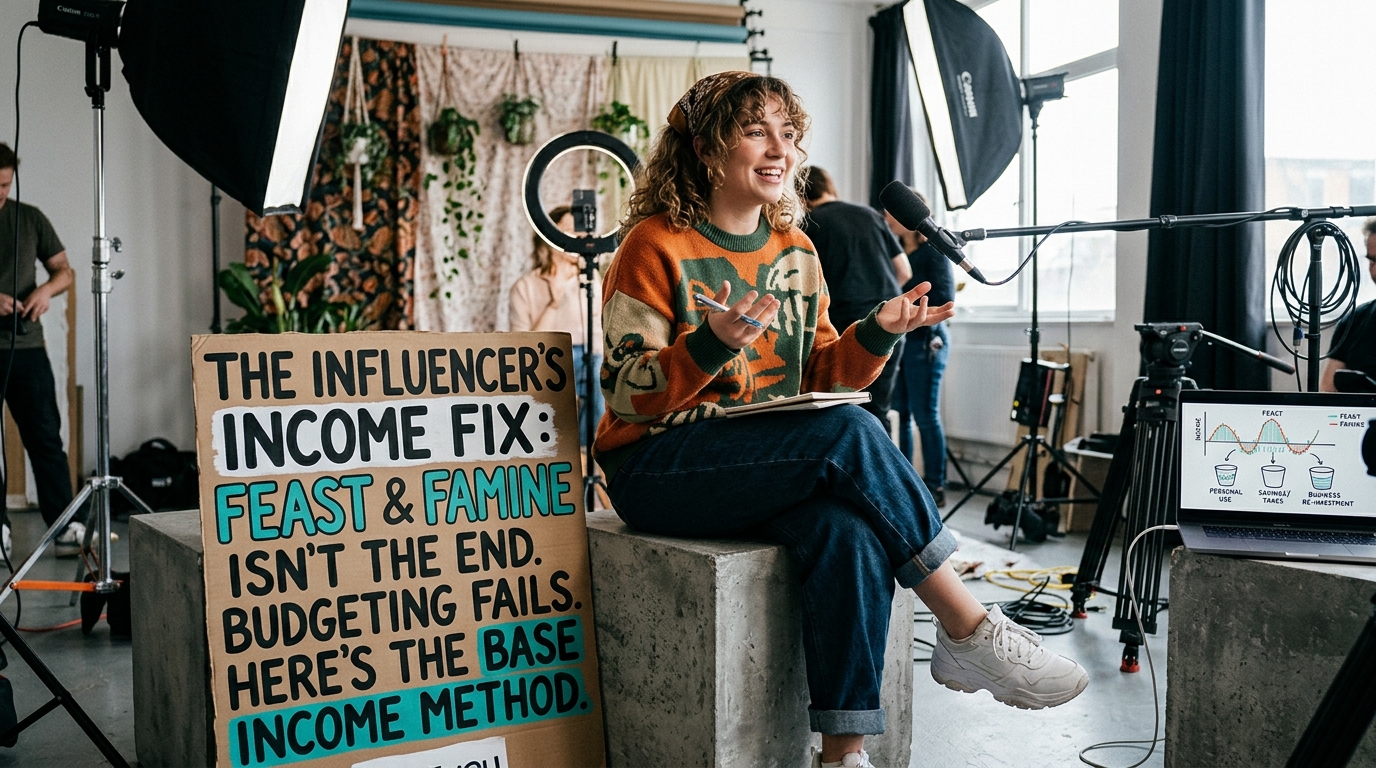
Influencer income is feast or famine. You might make $20,000 one month and $2,000 the next. Traditional budgeting advice — track your expenses, save a percentage of income, build a monthly plan — was designed for people with predictable paychecks. It does not work for this reality, and the creators who try to apply it usually find themselves either over-saving during good months in a way that feels unsustainable, or spending freely during good months and scrambling during slow ones. The solution is a different system entirely, built around the one number that is always true: your lowest month.
The Base Income Method
Building a budget around your floor, not your ceiling
Searchlight Social Framework
The Base Income Method
A four-step budgeting system for creators with irregular income — built around what is always true rather than what is occasionally true.
Find your base number — your lowest earning month in the past year
Pull your income data for the last twelve months. Find the lowest single month. That number — not your average, not your best month, not your most recent month — is your base income. Every lifestyle decision: rent, subscriptions, food budget, recurring expenses, gets built around that number. If you can fund your life on your worst month, every other month creates financial strength instead of just covering the gap.
Automate the money before you can spend it
The moment income arrives in your business account, three automated transfers should fire: 25–30% to your tax account, your designated monthly personal budget amount to your personal spending account, and any surplus above those two amounts to your savings and investment account. This is not willpower budgeting — it is structural budgeting. Most creators who struggle financially are not undisciplined. They just have all their money in one account where it all feels spendable.
Big months are not your new normal — treat every surplus as a buffer, not a raise
A $20,000 month does not mean your income is $20,000 a month. It means one month was exceptional. The surplus above your base goes into savings and taxes — specifically your emergency fund until it reaches six months of base expenses, then your retirement account contributions, then investment in income diversification. Every creator who has experienced financial instability describes the same pattern: spending big month income as though it would continue, then scrambling when it did not.
Review the base number every six months, not every month
As your income grows over time, your base number should rise with it — but on a six-month lag, not immediately. This prevents recent good months from inflating your lifestyle commitments before the growth is confirmed as sustainable. When your lowest month over the last six months is consistently higher than your previous base, update the number. Not before.
The four-account structure
The Base Income Method only works if the money is physically separated. Four accounts is the minimum viable structure for a creator with variable income.
Business operating account. All brand deal payments land here. This is not a spending account — it is a holding account from which your automated transfers fire. Nothing gets spent from this account except business expenses.
Tax account. 25–30% of every payment transfers here immediately and automatically. This account does not get touched until quarterly estimated taxes are due, or until year-end. It is not your money. Think of it as money you are holding on behalf of the IRS until they invoice you.
Personal spending account. Your designated monthly personal budget transfers here once a month from the business account. This is the only account you spend personal money from. Debit card, subscriptions, food, entertainment — all of it comes from here. When it is empty, the month is over for personal spending.
Emergency and goals account. Everything above your tax transfer and monthly personal budget goes here. It funds your emergency reserve, your retirement contributions, and your investment in additional income streams. This account only goes down in genuine emergencies — not slow income months, which your base income method already handles.
The one expense category that catches creators off guard
Health insurance. When you are employed, your employer covers a significant portion of your health insurance premium. As a self-employed creator, you cover 100% of it — which for comprehensive individual coverage in the United States typically runs $400–$800 a month depending on your age, location, and plan. This is a fixed monthly expense that many creators forget to account for when calculating what their base income in practice needs to cover. Build it into your base budget from the start, not as an afterthought when you realise you have been uninsured.
The financial mistakes article covers the broader patterns that derail creator finances — lifestyle inflation, tax gaps, and business structure. Once your budgeting system is stable, the revenue diversification article covers how to build income streams that reduce your dependence on brand deal variability entirely.
Frequently asked questions
How do influencers budget with irregular income?
Use the Base Income Method: calculate your lowest earning month from the past twelve months and build your entire budget around that number. Everything earned above that goes into savings and taxes before you can spend it. This means your lifestyle is always fundable on your worst month, and your good months build financial resilience rather than lifestyle upgrades you cannot sustain.
How many bank accounts should an influencer have?
At minimum four separate accounts: a business operating account where income lands, a tax account that receives 25–30% of every payment immediately, a personal spending account that receives only your designated monthly budget, and an emergency and goals account that receives everything else. The separation makes the money system automatic — you cannot spend tax money by accident if it sits in a separate account you do not touch.
What percentage of influencer income should go to taxes?
25–30% is a safe floor for US-based creators. Influencer income is self-employment income — you pay both the employer and employee portions of Social Security and Medicare taxes on top of regular income tax. The exact percentage depends on your total income, deductions, and business structure. Set aside 25–30% immediately until a tax professional gives you a number specific to your situation.
What is the Base Income Method for influencers?
A budgeting approach for irregular earners: find your lowest earning month from the past year and set that as your baseline monthly budget. All personal spending decisions — rent, subscriptions, food, lifestyle — are built around that number. When you earn more, the surplus goes to taxes, savings, and financial goals rather than lifestyle expansion. The method anchors your financial commitments to what is always achievable, not to what is occasionally achievable.
How do influencers save for retirement?
Self-employed creators have access to retirement accounts with higher contribution limits than standard employee plans — including SEP-IRAs and Solo 401(k)s. Both allow you to contribute a percentage of self-employment income and reduce your taxable income in the same year. Contribute in good months rather than committing to a fixed monthly amount that may be hard to sustain. Getting advice from a financial professional who understands self-employment income is the right starting point.
Discover more from SearchLight Social
Subscribe to get the latest posts sent to your email.