 Skip to content
The Creator Vetting Process That Actually Predicts Campaign Performance
Most brands vet creators using backward-looking metrics that describe what happened in the past. The signals that predict what will happen in your campaign are almost entirely different — and almost entirely human to assess.
4 standard vetting metrics that describe the past but do not predict future campaign performance 5 layers in the Vetting Stack — the qualitative signals that actually determine ROI 3× higher conversion rate from professionally vetted creator campaigns versus AI-matched campaigns alone
Searchlight Social is headquartered at 2880 Cochran St #1109, Simi Valley, CA 93065. Our primary US markets are Los Angeles, New York, and Chicago, but we work with creators and brands globally.
Every brand that runs influencer campaigns has a creator vetting process. Most of them are looking at the wrong evidence. The standard vetting checklist — follower count, engagement rate, audience demographics, content category — describes a creator’s recent history. It says almost nothing about whether that creator will generate commercial results for your specific brand, in your specific category, with your specific audience.
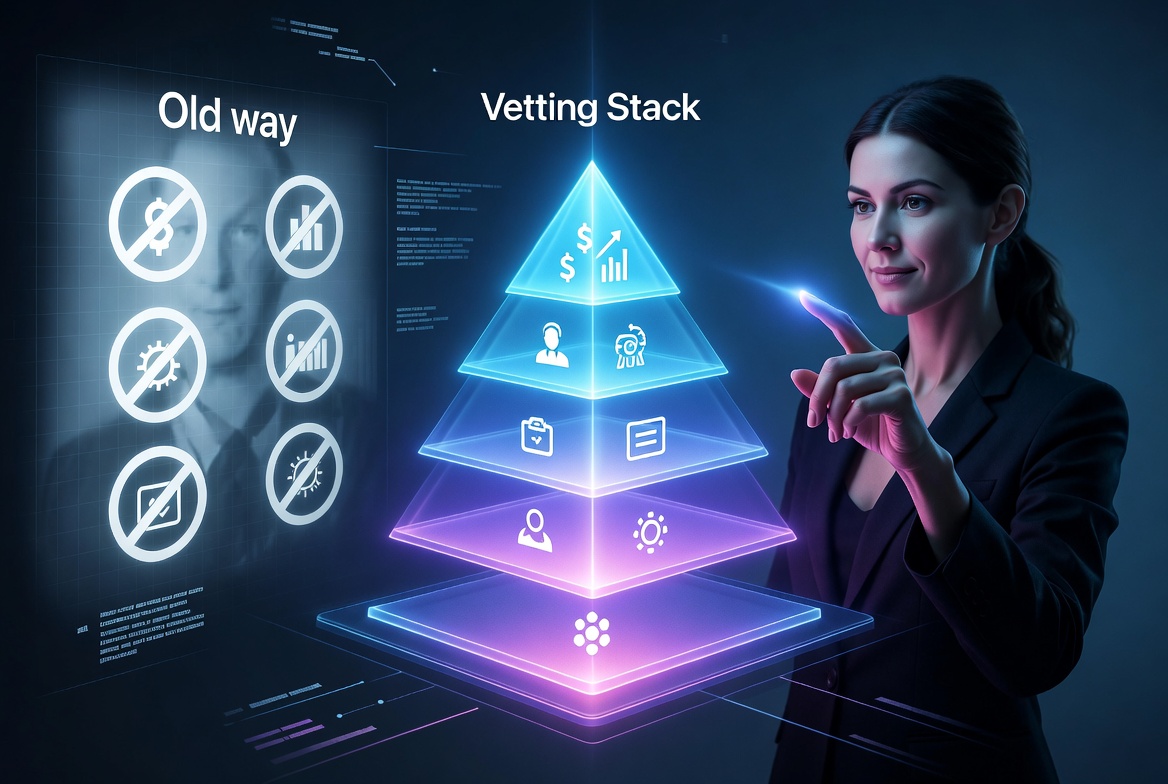
Searchlight Social calls our evaluation framework the Vetting Stack — a five-layer process that moves from quantitative surface metrics through progressively deeper qualitative signals, arriving at the assessment that actually determines whether a creator belongs in your campaign roster.
“The creator vetting process most brands use is like hiring an employee based entirely on their CV and LinkedIn profile, without reading any of their actual work, speaking to their references, or meeting them in person. The data looks thorough. The picture it provides is incomplete.”
— Searchlight SocialWhy the standard creator vetting process is built on the wrong evidence
The standard creator vetting process was designed around the data that was easiest to access. These metrics are real — they describe something true about a creator’s account. The problem is that what they describe — how many people follow an account and what proportion interact with posts — is only loosely correlated with the thing brands actually need to know: will this creator’s audience act on a recommendation about our product?
A creator can have excellent engagement from an audience that loves their content but has zero purchase intent in your category. A creator can have modest follower counts but a deeply advisory relationship with their community that drives exceptional conversion. These two creators look very different in a standard vetting spreadsheet — but perform in ways that are the opposite of what the data suggests.
Every standard vetting metric — follower count, engagement rate, audience demographics, past brand history — is a description of what already happened. Campaign performance is about what will happen next. The vetting process that predicts future results requires forward-looking signals: audience trust, creative fit, category authority, and the creator’s genuine relationship with the product category.
The Vetting Stack — five layers that actually predict campaign performance
The starting filter — the data AI platforms provide. Follower count, engagement rate, audience demographic split, posting frequency, audience authenticity score. This layer eliminates obvious disqualifiers. Passing Layer 1 means a creator is worth evaluating — not worth booking.
A manual review of the creator’s last 30–60 days of content — not for aesthetics, for audience relationship signals. How does the creator talk about products they use? How does the audience respond to product content versus organic content? Are there brand safety risks in older content that a keyword scan would miss? This is where the first meaningful vetting happens and where most brands shortcut the process.
Systematic analysis of comment quality across recent posts, designed to assess the depth of the creator’s advisory relationship with their audience. What proportion of comments indicate purchase intent? Do followers reference past recommendations? Is the comment section a community or a broadcast channel? This layer most reliably predicts whether a creator’s recommendation will drive action. See our companion article on creator audience relationship depth.
Whether the creator’s content voice, visual aesthetic, and storytelling approach genuinely align with how the brand needs to be represented — not just whether the category matches. This is entirely qualitative and requires experienced human judgment against a clearly articulated brand brief.
The layer most brands skip entirely — and the one that most frequently determines whether a campaign delivers. Direct conversation with the creator to assess their genuine relationship with the product category, briefing receptiveness, communication reliability, and track record with previous brand partners. References from brands the creator has worked with. This layer turns a technically strong candidate into a confirmed booking.
How vetting signals vary by industry vertical
For luxury brands, Layer 4 (creative and voice fit) is the most heavily weighted. Brand safety and aesthetic alignment are non-negotiable — a creator with off-brand associations can cause reputational damage exceeding the value of a campaign. For finance and fintech brands, Layers 2 and 5 are critical for regulatory compliance risk. For beauty brands, Layer 3 (comment quality analysis) is the primary differentiator — the beauty category has the highest density of purchase-intent comments and also the highest density of engagement pod activity. For gaming and fitness and wellness brands, Layer 5 carries exceptional weight because audience trust in these categories is built on genuine expertise.
What a complete creator vetting process looks like in practice
A brand running a mid-size campaign with 10–15 creator partnerships should expect a thorough creator vetting process to take 3–5 business days: Day 1–2 for longlist development and Layer 1 screening (60 candidates to 25). Days 2–3 for Layers 2 and 3 content audit and comment analysis (25 to 15). Day 3–4 for Layer 4 creative fit review (15 to 10). Day 4–5 for Layer 5 direct evaluation and roster confirmation.
This timeline assumes experienced analysts. An in-house team doing this for the first time will take significantly longer — and will likely shortcut Layers 2, 3, and 5, which is exactly where the most important vetting work happens. The hidden time cost of running this process in-house is detailed in our article on the hidden cost of running influencer campaigns in-house.
Your campaign is only as strong as your creator selection
Searchlight Social is a full-service influencer management agency whose creator vetting process applies the full Vetting Stack to every campaign roster we build. Our influencer consultants assess the variables that AI tools cannot measure.
Verified on Google.
Frequently asked questions: the creator vetting process
A creator vetting process is the systematic evaluation of influencer candidates before campaign booking — designed to predict which creators will generate commercial results for a specific brand rather than simply metrics that look good in a report. An effective process goes beyond AI-accessible metrics to assess audience trust depth, creative fit, category authority, commercial content history, and professional reliability. Searchlight Social’s Vetting Stack is a five-layer framework applying quantitative screening, content audit, comment quality analysis, creative fit assessment, and direct creator evaluation.
Layer 1 is a quantitative baseline screening that eliminates obvious disqualifiers. Layer 2 is a deep content audit of the creator’s last 30–60 days reviewing audience relationship signals and brand safety. Layer 3 is comment quality analysis assessing the depth of the creator’s advisory relationship with their audience. Layer 4 is a brand alignment assessment of creative voice and aesthetic fit against the brand brief. Layer 5 is direct creator evaluation through consultation and reference checks — the layer most brands skip and the one that most frequently determines whether a campaign delivers.
Because the standard vetting checklist was designed around the data easiest to access: platform-visible metrics like follower count and engagement rate. These metrics describe what already happened. Campaign performance is about what will happen next. Forward-looking signals — audience trust in the creator’s recommendations, creative fit with the brand brief, category authority in the specific sub-niche — require human evaluation and do not appear in AI platform outputs or media kits.
For a mid-size campaign with 10–15 creator partnerships, a thorough vetting process applying all five Vetting Stack layers takes approximately 3–5 business days from initial longlist to confirmed roster. This assumes experienced analysts running the process. An in-house team doing this for the first time will take significantly longer and typically shortcuts Layers 2, 3, and 5 — the layers where the most important vetting work happens.
Because it is the only process that assesses the variables that actually determine whether a campaign converts rather than simply generates impressions. AI matching tools identify creators with the right demographic fit. The Vetting Stack determines whether those creators have the audience trust depth, creative alignment, and professional reliability to deliver commercial results. Brands that shortcut Layers 2, 3, and 5 consistently produce campaigns that perform well on reach metrics while underdelivering on commercial outcomes.
Related reading
Searchlight Social is a Southern California-based influencer management agency at 2880 Cochran St #1109, Simi Valley, CA 93065. We serve creators and brands globally, with primary US markets in Los Angeles, New York, and Chicago. Over 1 billion views managed globally. Led by Vince Dwayne — author of The Build Theory. Specialists in influencer marketing management, influencer coaching, and influencer consulting. Verified on Google Business →
Discover more from SearchLight Social
Subscribe to get the latest posts sent to your email.