 Skip to content
Creator Strategy / Brand Deals
Average Views or Median Views? What Should Set Your Rate
The standard pricing formula uses average views. One viral video makes that number a lie, and it works against you in both directions.
The closest thing this industry has to a standard rate formula is average video views multiplied by a target CPM. It appears in most 2026 pricing guides, brands use it to set budgets and creators use it to set floors. It rests on a statistic that is wrong for the job, and almost nobody says so.
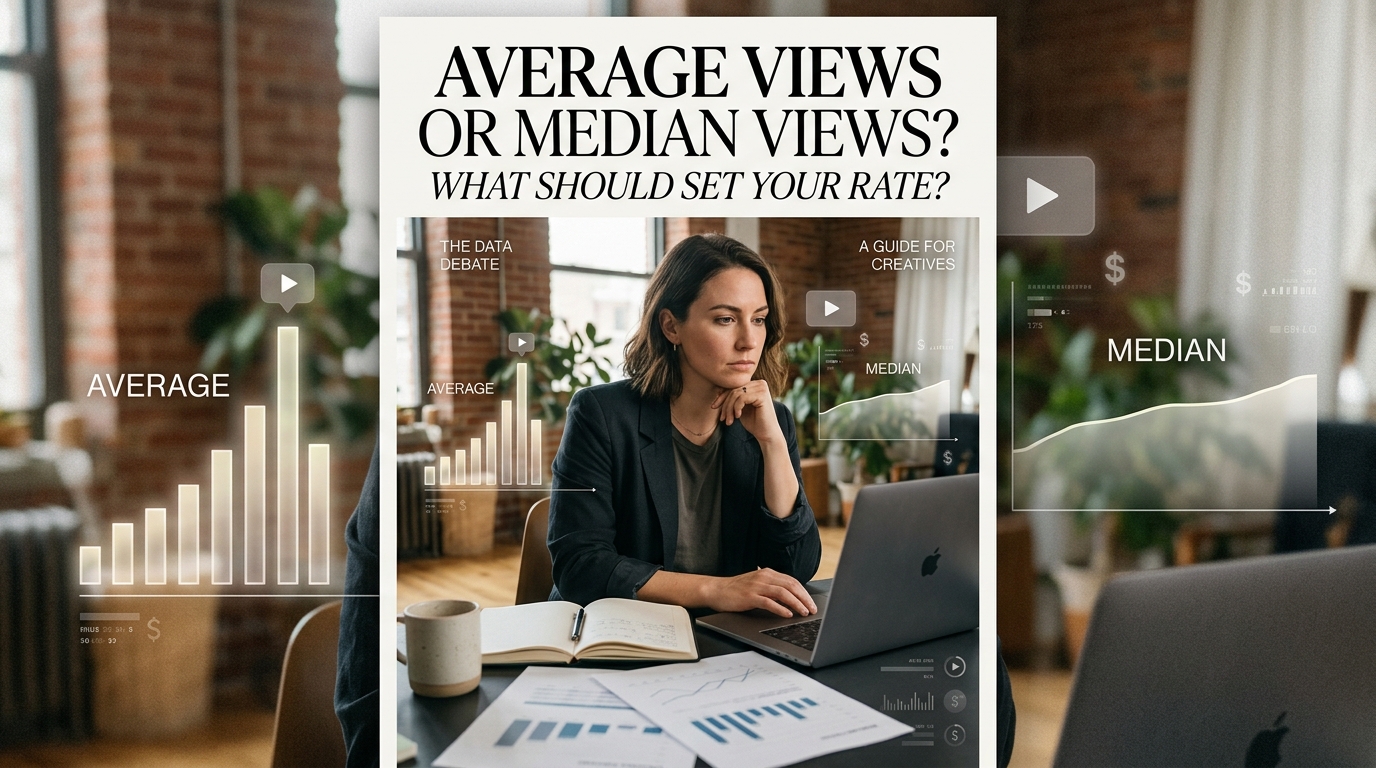
Use median views rather than average views when setting a rate. The average is pulled upward by a single outlier, so a creator whose typical video reaches 12,000 people can show an average of 40,000 after one video did 300,000. Price off that average and the brand pays for reach that will not arrive. Price off the median and both sides are working from the number the next video is likely to produce.
Searchlight Social negotiates creator rates across Los Angeles, New York, and Chicago.
We are a coaching-first, non-exclusive influencer management agency based in Simi Valley, California. Verify us on Google Business Profile.
Source note: the average-views formula comes from PlutoBa, and CPM ranges from Influencer Marketing Hub and Influencer Advisory. The Outlier Distortion and the median recommendation are Searchlight Social analysis. The worked examples are illustrative rather than drawn from client data. My commentary comes from negotiating creator agreements and is labelled as such.
What is the standard influencer rate formula?
Average video views multiplied by a target CPM, divided by a thousand. PlutoBa describes this as the closest thing to an industry standard, quoting CPM ranges from $8 to $50 by platform and category. Influencer Marketing Hub puts influencer CPMs between $5 and $25, while Influencer Advisory reports a working band of $15 to $80. A creator averaging 50,000 views at a $15 CPM prices at $750 a post.
The formula is sound. The problem sits in its first input, because average views is the wrong measure of what a creator reliably delivers.
Why does one viral video distort a rate?
The Outlier Distortion
Because the average includes it and the median does not. Nine posts landing between 9,000 and 15,000 views, plus one that reached 300,000, gives an average of 41,700 and a median of 12,000. At a $15 CPM that is $626 a post against $180. Same creator, same ten videos.

This is the failure mode built into the standard formula. The Outlier Distortion is the inflation of a creator’s apparent reach when a single unusually successful post is included in an average, producing a pricing input that neither the creator nor the brand can expect the next video to match, and which misprices the deal in whichever direction the outlier falls.
| Measure | Views | Rate at $15 CPM | What it predicts |
|---|---|---|---|
| Average of all ten | 41,700 | $626 | A result that happened once |
| Median of all ten | 12,000 | $180 | What the next post will likely do |
| Average excluding the outlier | 12,000 | $180 | The same as the median |
Notice the third row. Once the outlier is removed, average and median agree. The gap between them is a measure of how much one post is doing to the number.
Who does the average hurt?
Both sides, at different moments. A brand paying off the average buys reach that does not arrive and concludes the campaign underperformed. A creator pricing off the median while a rival prices off their average looks expensive on your spreadsheet and loses the deal to somebody whose numbers were flattered.
The second one is worth sitting with, because it is why this persists. If the market prices off averages, a creator who prices accurately is undercut by one who does not, and the accurate price looks like a worse deal on a spreadsheet.
That is a coordination problem rather than a moral one. It resolves when brands start asking for the median, which costs them nothing and immediately makes the comparison fair.
How many posts should you measure?
Between nine and thirty, and consistently. Fewer than nine and a single result still moves the number too much. More than thirty and you are averaging in content from a period when the channel was different, which is its own distortion on a platform that changes distribution every few months.
Whichever window you pick, use the same one on both sides of the table. A brand measuring the last nine posts against a creator quoting from their last three months is not comparing the same thing, and the disagreement that follows looks like a negotiation when it is arithmetic.
State the window in the conversation. Median views across your last twenty posts is a sentence that removes an entire category of dispute.
What should a brand ask for?
Median views across a stated recent window, and the range around it. The median tells you what to expect. The range tells you how volatile the channel is, which matters if the campaign has a date attached and you need a floor rather than an expectation.
A creator whose posts land between 9,000 and 15,000 is a different purchase from one whose posts land between 2,000 and 90,000, even if both have a median of 12,000. The first is predictable. The second is a bet.
Neither is worse. They should be priced differently, and the average conceals the distinction entirely.
When is the average the right number?
When you are buying a portfolio rather than a post. If a campaign runs twenty creators, the outliers across that group start behaving like a distribution rather than an accident, and total expected reach across the programme is a reasonable thing to average.
The same applies to a long-running relationship. Across twelve posts with one creator over a year, the occasional breakout is part of what you are buying, and pricing it out entirely underpays them.
So the rule is not that averages are wrong. It is that a single-post deal should be priced on what a single post will probably do, and that is the median.
How should a creator quote a rate?
Median across your last twenty posts, with the window named and the range shown. Naming the window makes the number checkable, which makes it credible. Showing the range communicates consistency, which the median alone cannot. And if you want the upside, price the outlier separately as a performance bonus rather than folding it into your base.
- Calculate your median across your last twenty posts. Not your best month, not your average, and not your follower count.
- Name the window when you quote. Saying the number came from your last twenty posts makes it checkable, which makes it credible.
- Show the range alongside it. If your posts land consistently, that consistency is worth money and the median alone does not communicate it.
- Price the outlier separately if you want to. A performance bonus above an agreed view threshold captures the upside without inflating the base.
- Do not quote off average views because a competitor does. You will win some deals and set a rate you cannot deliver against, which costs the rebooking.
That last point is the one I make most often in coaching. A rate you cannot hit is not a win. It is a deal you have to explain afterwards.
Questions about views and rate-setting
Should influencer rates use average or median views?
Median, for single-post deals. The average is pulled upward by one outlier, so a creator whose typical video reaches 12,000 can show an average of 41,700 after one post hit 300,000. At a $15 CPM that is the difference between a $180 rate and a $626 rate for the same channel.
What is the standard influencer rate formula?
Average video views multiplied by a target CPM, divided by a thousand, with published CPM ranges running from about $8 to $50 depending on platform and category. The formula itself is sound; the weakness is using average views as the input rather than median views.
How many posts should you measure to set a rate?
Between nine and thirty. Fewer than nine and a single result still distorts the number. More than thirty and you are including content from a period when the channel behaved differently. Whichever window you choose, both sides should use the same one and say so.
When is average views the right measure?
When buying a portfolio rather than a single post. Across twenty creators, or across a year-long relationship with one, occasional breakout posts behave like a distribution rather than an accident and form part of what is being purchased. A single-post deal should be priced on what a single post will probably do.
What should a brand ask a creator for?
Median views across a stated recent window, plus the range around it. The median predicts the next post; the range shows volatility. A creator landing between 9,000 and 15,000 views is a different purchase from one landing between 2,000 and 90,000, even with the same median.
Quote a number you can deliver against
Searchlight Social coaches creators on rate-setting, starting with the numbers that predict the next post rather than the ones that flatter the last one.
Searchlight Social
2880 Cochran St #1109, Simi Valley, CA 93065
+1 (805) 850-3103 · info@searchlightsocial.com
Serving Los Angeles, New York, and Chicago · Google Business Profile · Contact
Discover more from SearchLight Social
Subscribe to get the latest posts sent to your email.