 Skip to content
Every Revision Round in the Brand Deal Approval Process Is Costing You Performance You’ll Never Get Back
Brand content has a performance window. It peaks in the days and weeks after posting, then declines. Every day spent in revision cycles is a day of peak performance lost permanently. Most creators absorb this cost invisibly. Here is how to see it, calculate it, and negotiate it into every brand deal.
Overview — Insights
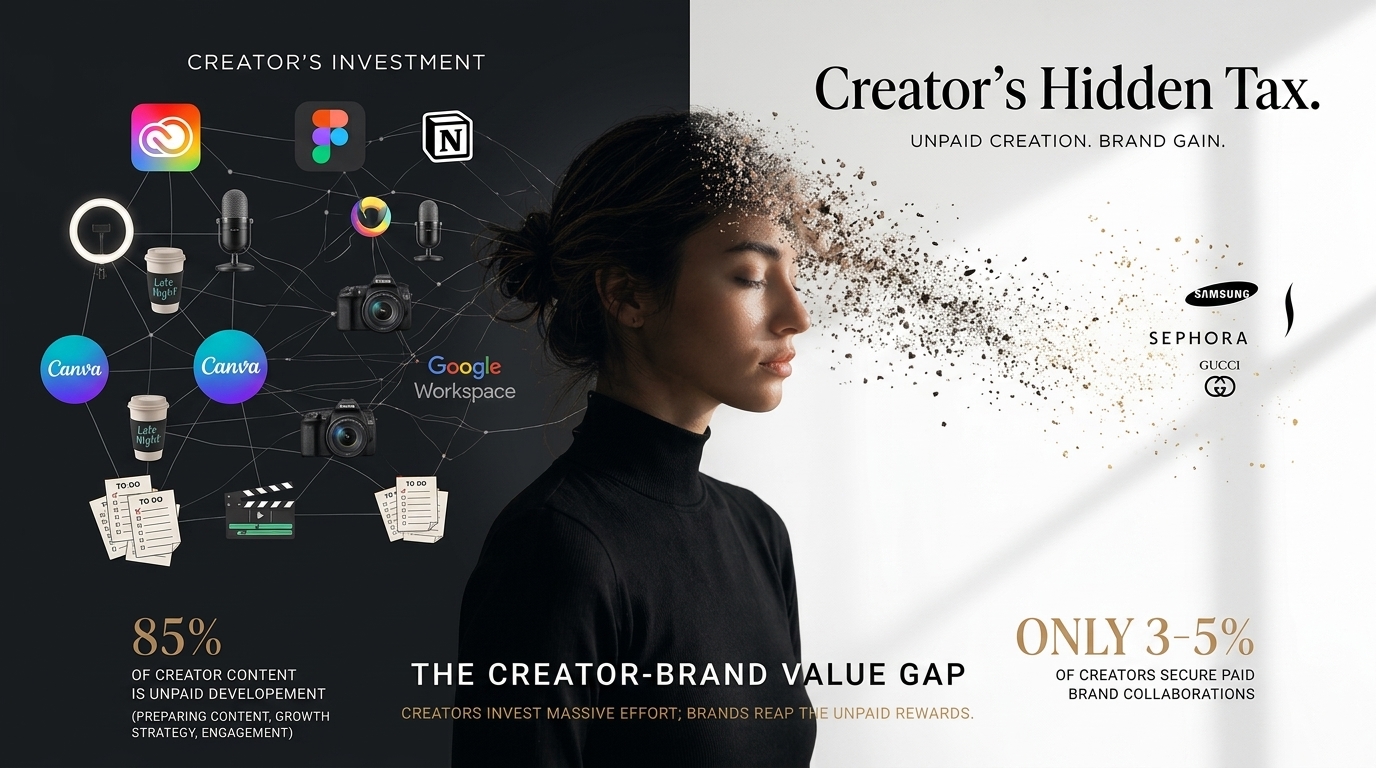
The Approval Delay Tax is the performance cost of the brand deal approval process — specifically the portion of your content’s peak performance window consumed by revision rounds before posting. Creator content performs best in the days and weeks immediately after publication. Approval delays shift the posting date forward, compressing the peak window or eliminating it entirely. This performance cost is real, measurable, and falls entirely on the creator (whose engagement and algorithm distribution suffers) rather than on the brand (which caused the delay). Most creators never name it. Fewer still negotiate it.
Searchlight Social — Service Area
Searchlight Social · 2880 Cochran St #1109, Simi Valley, CA 93065 · +1 (805) 850-3103 · info@searchlightsocial.com
Our primary US markets are Los Angeles, New York, and Chicago, but we serve creators and brands globally. Talk to a social media consultant in Los Angeles or work with our influencer marketing agency in Los Angeles.
The hidden cost of the brand deal approval process
Here is what most creators experience in a brand deal approval process. Content is submitted. Three days pass. Minor feedback arrives. You revise. Two more days pass. Additional feedback. You revise again. Final approval comes on day nine. You post.
The post performs fine. Not as strongly as your organic content posted the same week. The algorithm does not distinguish between a delayed brand post and a fresh piece of content — it treats both as newly published. But audiences have already moved on from the topics and trends active when you first submitted. The performance window has partially expired.
This nine-day delay cost you something real, but no invoice captures it. Industry research from the Influencer Marketing Hub Benchmark Report confirms brand-creator workflows now run through multi-stakeholder approval chains, while Instagram for Business guidance shows posting timing materially affects distribution. Pew Research has also documented how quickly social audiences shift attention across topics and formats. Nobody compensates you for the window you lost. Nobody even names it as a cost.
“Every day in revision is a day of peak performance window gone. The brand caused the delay. The creator absorbs the cost. Most creators never even notice it as a cost — let alone negotiate it.” — Vince Dwayne, Searchlight Social
How to address the brand deal approval process tax in every deal
The Approval Delay Tax is not a fixed cost of doing business. It is a negotiable commercial term, hiding in plain sight because brands rarely surface it and creators rarely price it. Once you name it as a cost, you can structure the deal around it. The five dimensions below move the cost from invisible to contractual.
None of these dimensions require difficult conversations. They require deal language. Brands negotiate language. They negotiate contracts. What they will not negotiate are informal assumptions — and the Approval Delay Tax sits inside informal assumptions for most creators today.
Work through the dimensions in order. Each one stands alone, but together they convert the approval process from a hidden tax on creator performance into a defined commercial parameter inside the deal structure.
Searchlight Social Framework
The Approval Delay Tax
Five ways to address approval delays — from mapping the timeline upfront to building contractual protections that compensate for excessive delays.
Map the brand deal approval process timeline upfrontAD-1
Before signing anything, request the brand’s standard approval timeline — how many stakeholders review content, how many revision rounds they typically run, how long each round takes. Brands rarely volunteer this data, but most can answer when asked directly. The information shapes your deal economics. A campaign with a one-pass approval and a 48-hour turnaround is a fundamentally different commercial proposition from a campaign with three stakeholder reviews and a seven-day average cycle. Map the timeline at the briefing stage. Build it into your rate calculation, your content calendar, and the posting window you commit to. Mapping turns an invisible cost into a visible negotiation input.
Name the performance window in your deal structureAD-2
Add explicit language to your deal memo or contract: “Content will be posted within [X] days of final approval. Performance may be affected by approval delays beyond [Y] business days.” This language does not prevent delays. It does something more useful — it makes the performance window a visible contractual element rather than an informal assumption. Brand teams understand contracts. They negotiate contracts. They do not negotiate informal assumptions because informal assumptions never reach the negotiation table. By moving the performance window into the deal structure, you create the basis for a compensation conversation when delays exceed the agreed timeline. Most brands will accept the language without resistance.
Add an approval timeline clause to your contractAD-3
Specify the maximum revision round timeline directly in the deal contract. Standard wording: brand will provide consolidated feedback within two business days of content submission. Add an escalation clause: if approval extends beyond seven business days, the creator is entitled to an extended posting window or a rate adjustment. Two business days is a reasonable commitment that most brand teams can meet when they coordinate internally. Seven business days is a generous outer bound. If a brand resists either commitment, the resistance itself tells you something useful about their internal approval process. Resistance is a signal, not a relationship problem.
Price the delay cost into your rate from the startAD-4
If your records show a specific brand runs a seven-day approval process with three revision rounds, price that into your rate before the conversation begins. A brand asking for three revision rounds and a seven-day window asks for significantly more of your time. It carries more performance risk and consumes more calendar than a two-day single-pass review. These are different commercial propositions, and they justify different rates. Pricing this in does not require explanation or disclosure — your rate is your rate. But it does require tracking. Without records of past approval behaviour by brand, you cannot price the delay cost accurately.
Separate scope revisions from preference revisionsAD-5
Not every revision is in scope. Changes that address compliance issues, brand safety concerns, or meaningful positioning shifts are within the scope of the brief you agreed to. Changes driven by subjective stakeholder preference, internal disagreements at the brand, or post-brief scope expansion are outside scope. Outside-scope revisions are legitimate grounds for either a revised timeline, a revision fee, or both. Document this in the contract before signing rather than in the moment after the revision arrives. The distinction sounds technical, but it changes the relationship. In-scope feedback gets addressed. Out-of-scope feedback gets a quote. That structure protects your time and your rate.
Why the brand deal approval process is a negotiable commercial term
Approval delays carry real costs. Platform algorithms penalise delayed posting. Audience relevance decays as trends move on. Your time gets consumed by revision rounds outside the original deal scope. And calendar days disappear into the approval process itself.
These costs are real. They are also addressable through deal structure rather than absorbed silently. A brand that values your commercial contribution is a brand that will discuss reasonable approval timeline expectations. A brand that treats the approval process as outside the commercial negotiation is a brand that has not fully registered the commercial relationship.
For TikTok creators and Instagram creators especially, where platform distribution is most sensitive to posting timing and trend relevance, the Approval Delay Tax becomes a significant commercial issue. Content tied to a current trend, audio, or format can lose most of its distribution advantage if the approval process runs past the trend window.
Brand deal approval process in the United States
US brand deal approval processes vary sharply by market and category. In Los Angeles, entertainment and lifestyle brands typically run lean approval chains — often two to three stakeholders, with three-to-five business day cycles. New York runs the longest approval chains in the country. Its fashion, finance, and CPG brands routinely involve legal, brand, regulatory, and procurement reviews — extending cycles to seven-to-ten business days. Chicago sits in the middle, where B2B, healthcare, and food brands run structured approval processes but typically with fewer stakeholders than New York.
The implication is direct: a New York fashion deal at the same headline rate as a Los Angeles lifestyle deal is not the same deal. The approval process consumes different amounts of creator time, different amounts of performance window, and different amounts of calendar. Creators working across US markets benefit from market-specific rate adjustments, not flat rate cards.
| Market | Typical approval cycle | Performance window risk |
|---|---|---|
| Los Angeles — Entertainment & lifestyle | 3–5 business days · 2–3 stakeholders | Moderate; trend windows still partially preserved |
| New York — Fashion & CPG | 7–10 business days · 4+ stakeholders | High; trend windows usually expired by post date |
| New York — Finance & fintech | 10–14 business days · legal-led chain | Very high; evergreen content essentially required |
| Chicago — B2B & healthcare | 5–7 business days · structured review | Moderate-to-high; topical relevance often decays |
| National — DTC startups | 1–3 business days · founder-led approval | Low; peak window typically intact at posting |
Brand deal approval process internationally
International approval processes diverge from US norms. In the United Kingdom, ASA disclosure compliance adds a regulatory review layer that extends approval cycles by one-to-two business days versus comparable US deals. Canadian approval processes mirror US patterns but carry greater French-language localisation overhead in Quebec-targeted campaigns. Australian deals fall under the AANA Code of Ethics, which functions similarly to UK ASA review and adds a regulatory checkpoint to most brand-led campaigns. Creators operating across these markets benefit from market-aware approval clauses rather than a single US-default contract template.
1B+
views managed
40–120%
rate uplift achieved
12+
verticals served
8+
proprietary frameworks
Stop absorbing brand deal approval process costs silently
Searchlight Social is a Los Angeles-based influencer management and coaching agency founded by Vince Dwayne. Vince is the author of The Build Theory: How Great Social Media Content Is Built (also available at Barnes & Noble). Our management model includes approval timeline clauses in every brand deal contract as standard. We track approval process behaviour across all brand partners and address delays as contractual matters rather than informal relationship issues.
Talk to us through one of our Los Angeles practice areas:
Frequently asked questions about the brand deal approval process
Why does the brand deal approval process take so long?
Multiple internal stakeholders — legal, brand, marketing, sometimes procurement — all review content before approval. Each review adds time, and feedback often arrives in batches from different stakeholders rather than consolidated. The process is not designed with the creator’s performance window in mind. It is designed with brand compliance in mind. Understanding this makes the solution clearer: you address it through deal structure (approval timeline clauses) rather than through the relationship (asking nicely for faster feedback).
What is the Approval Delay Tax?
Searchlight Social’s name for the performance cost of lengthy brand deal approval processes. Creator content performs best in the days and weeks immediately after posting. Approval delays shift the posting date forward, consuming the peak performance window. This cost is real, measurable, and falls entirely on the creator even though the brand causes it. There are five ways to address it. Map the approval timeline upfront. Name the performance window in your deal structure. Add an approval timeline clause to your contract. Price the delay cost into your rate. And separate in-scope from out-of-scope revisions.
Can I charge more for a brand deal with a lengthy approval process?
Yes — and it is commercially justified. A brand with a seven-day approval cycle and multiple revision rounds creates more total work. It carries more performance risk than a brand with a two-day single-pass approval. These are different commercial propositions. A rate card or deal structure that acknowledges the difference is both commercially accurate and professionally defensible. Track each brand’s approval behaviour so the rate adjustment is data-backed rather than a hunch.
What should I do if a brand keeps asking for revisions?
First, check whether the revisions are within the scope of the original brief. Changes that address compliance issues or meaningful brand positioning are within scope. Changes driven by subjective preference, stakeholder disagreements within the brand team, or post-brief scope changes are outside scope. Outside-scope revisions are legitimate grounds for either a revised timeline, a revision fee, or both. Address this in the contract before signing rather than in a conversation after the revisions arrive.
How do I negotiate a faster brand deal approval process?
Include a specific approval timeline clause in the deal contract: “Brand will provide feedback within two business days of content submission.” Most brands will agree to this because it also benefits them — a faster approval process means faster posting and faster campaign delivery. If a brand resists a two-business-day commitment, ask what timeline they can commit to. Getting a commitment on paper changes the dynamic from “please respond faster” to “this is what we agreed.”
Where in Los Angeles can creators get help with brand deal approval process negotiations?
Searchlight Social operates as a social media coach in Los Angeles for creators navigating brand deal negotiations. The work covers approval timeline clauses, revision scope language, and rate adjustments tied to approval behaviour. The coaching programme works one-to-one with creators across Los Angeles, Ventura County, and Orange County. Remote coaching is available for creators in New York, Chicago, and internationally. The coaching covers contract review, deal structure, and the specific language that addresses the Approval Delay Tax inside the deal rather than around it.
More from the What Nobody Tells You series
Discover more from SearchLight Social
Subscribe to get the latest posts sent to your email.